
Quick Summary: Why You Can't Delete a Partition & How to Fix It
The Core Obstacle: Windows bars you from deleting a partition using Disk Management if it contains active system boot configurations, a virtual memory pagefile allocation, or is protected by the operating system as an EFI System Partition or OEM Recovery Volume. In these scenarios, the "Delete Volume" choice is greyed out.
The Command-Line Bypass: Launch Command Prompt as Administrator and utilize the DiskPart Override Engine to drop security flags. Run:diskpart -> list disk -> select disk # -> list partition -> select partition #
Execute the raw structural bypass command line:delete partition override
The Visual GUI Solution: For system C: drives or write-locked volumes, utilize a partition manager like AOMEI Partition Assistant Standard to build a bootable environment, bypass runtime operating system locks, and wipe the block layers without risk of blue-screen crashes.
The Safest Recovery Path: Wiping or deleting partitions unallocates your storage sectors and strips data tables. If you drop a volume without a current backup, use a data recovery program like Wondershare Recoverit to scan the unallocated drive blocks and rebuild your missing partition boundaries.
Part 1. Why Can't I Delete a Partition on Windows 10/11?
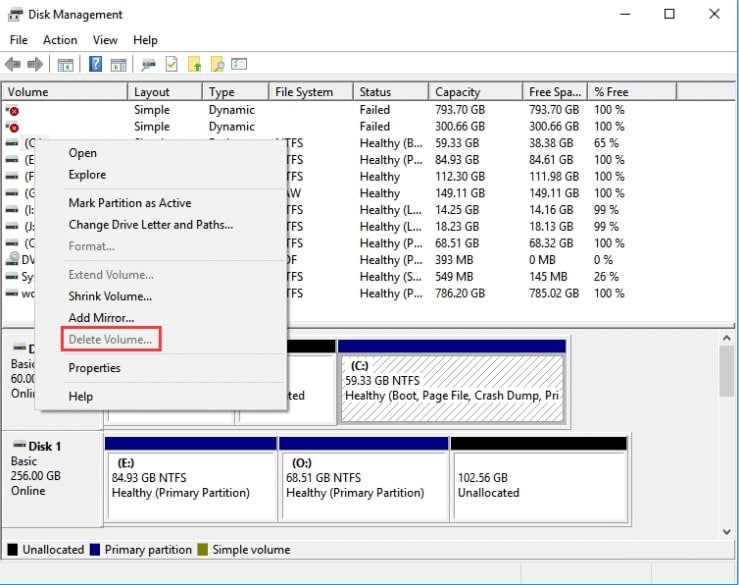
Deleting hard drive partitions is necessary, particularly if you are running low on disk space. In such cases, users usually delete the volume that isn't being used to make room for the volume that is nearly full. The Disk Management utility is typically used to delete hard drive partitions. However, there are some cases where the 'Delete volume' option is greyed out, wherein users cannot delete partitions in Windows 10/11.
Diagnostic Guide: Volume Structural Locks
Partition Target Profile |
The Underlying Root Cause |
Required Override Tool System Path |
Risk of System Crash |
| EFI / OEM Recovery | Hidden system sector protected by Windows protection attributes. | Method 1: DiskPart Terminal Configuration | Low (Safe if target index is correct) |
| System (C:) Drive | Contains active kernel components, boot structures, and OS configurations. | Method 2: Bootable GUI Partition Tool | Critical (Requires OS migration path) |
| Pagefile / Dump Volume | Actively locked by the Windows Virtual Memory Management framework. | Advanced Settings System Property Adjustment | Low (Requires reboot allocation) |
| External Removable Flash | Legacy Master Boot Record (MBR) limitations or active hardware write-protection. | Method 1 or Method 2 Core Interface Engines | Zero |
Utility Processing Matrix
Resolution Tool Path |
Operational Interface |
User Target Experience Level |
Best Application Scenario |
| DiskPart Command Console | Command-Line Interface (CLI) | IT Admins, Power Users, Technicians | Forcing deletion of stub-born OEM Recovery or EFI volumes without extra downloads. |
| Third-Party Partition Software | Graphical User Interface (GUI) | Everyday Users, General Beginners | Safely wiping active operating system volumes via a pre-OS environment. |
The following are some of the situations wherein the Delete Volume option is disabled, and you cannot delete the partition:
Removing the OEM/Windows recovery partition
The recovery partition can take up several GB, so it's okay to delete it to free up disk space. However, because the recovery partition is hidden and protected, you cannot delete it in Disk Management.
Deleting the partition from your USB flash drive or SD card
If your operating system is NOT Windows 10 version 1803 or later, you cannot remove the partition from the USB flash drive, or the SD card will be considered a removable device.
Eliminating the system boot partition
Unfortunately, when you want to delete the system C drive in Windows 10/11 Disk Management, the "Delete Volume" option is greyed out. This is because the C drive contains OS boot files for booting and cannot be removed from within Windows.
Because the error isn't the result of various factors, it can fix this problem with two simple solutions listed below.
Solution Type |
Solutions |
Ease of Use |
Application |
| Command Line Tool | Fix can't delete the partition using DiskPart | Hard | Suitable for professional users or IT experts |
| GUI Tool | Fix can't delete the partition using the free partition manager | Easy | Suitable for all levels of users |
Method 1: Fix Can't Delete Partition Using DiskPart CMD
DiskPart, a command-line tool in Windows, lets you create primary or logical partitions, convert FAT32 to NTFS without formatting, and delete OEM recovery partitions, among other things. Here's how to delete a partition in DiskPart step by step:
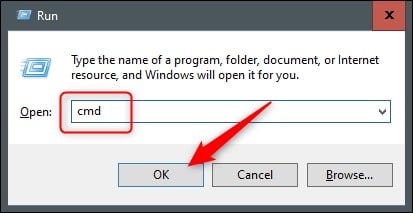
Step 1. Press Windows + R to open the Run box. Type cmd and click OK.
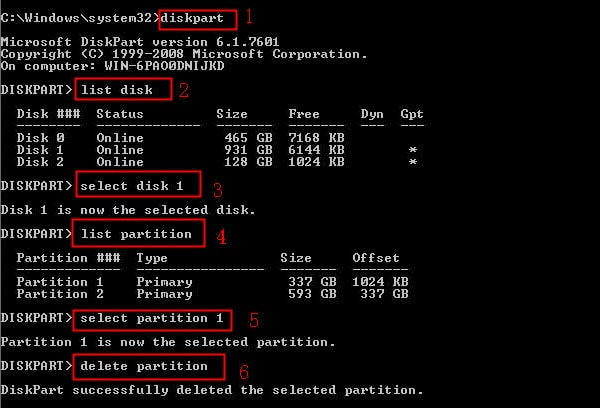
Step 2. To delete a partition from your computer, execute the following commands one after the other:
DiskPart
list disk
selected disk #
list partition
select partition #
delete partition
Command |
Description |
list disk |
Identifies all connected drives. |
select disk # |
Replace # with your disk number (e.g., select disk 1). |
list partition |
Shows all volumes on that disk. |
select partition # |
Choose the partition that was greyed out. |
delete partition override |
Forces deletion of hidden or protected partitions. |
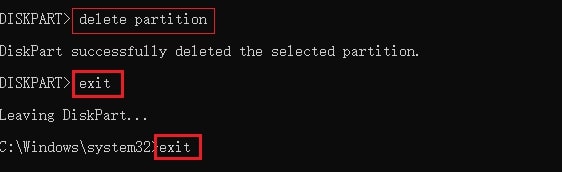
Step 3. Type Exit to close the partition deleting process after seeing the message “DiskPart successfully deleted the selected partition.”
Pro Tip: Bypassing the VDS 'Access is Denied' Error in Modern Environments
Even when utilizing DiskPart, you may occasionally run into an “Access is Denied” loop when using the regular delete command string on modern high-speed NVMe solid-state storage. This occurs because the Windows Virtual Disk Service (VDS) maintains a real-time system file thread lock on hidden partitions if modern cloud backup agents or background disk optimization engines are indexing the drive structures.
To resolve this issue, apply the override modifier at the end of your instruction string. This forces your storage device's storage-class driver stack to drop all current access handles, immediately deleting the partition without forcing a system reboot.
Pros
Get more disk partition control than Disk Management.
Orders to the operating system are processed quickly.
Cons
It is challenging to run.
There are no undo options.
There is no confirmation of the option, and it is easy to make mistakes.
False commands can cause serious errors.
Method 2: Fix Can't Delete Partition Using Third-party Tool With GUI Interface
If you can't delete a partition in Windows 10/11, you can use AOMEI Partition Assistant Standard, a third-party GUI partition manager. It has a user-friendly and concise user interface, allowing you to easily remove a system partition, hidden recovery partition, or delete a partition.
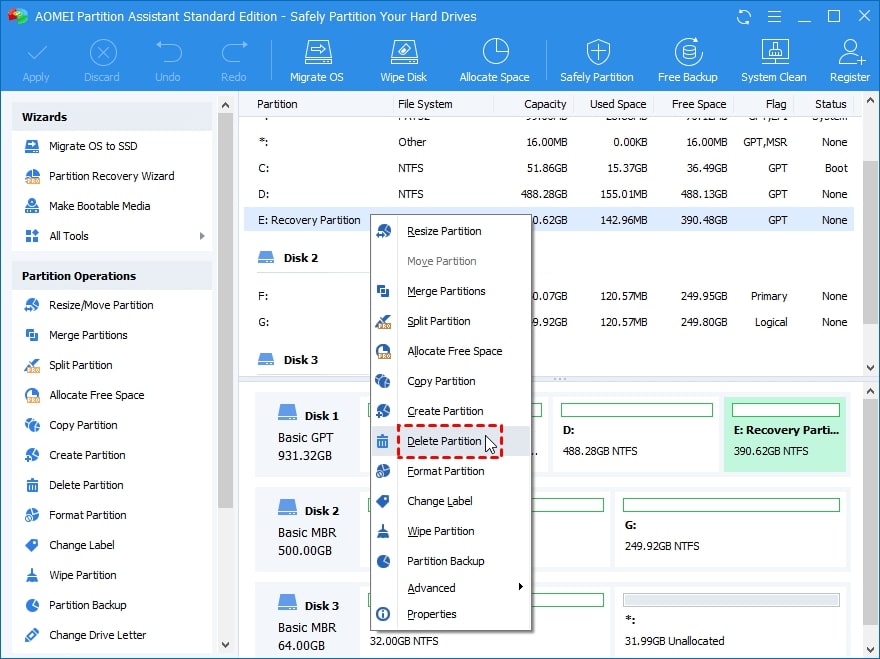
Step 1. Install and launch the AOMEI Partition Assistant Standard. You can see your computer's disks and partitions in the main interface. Right-click the partition you like to delete and select Delete Partition.
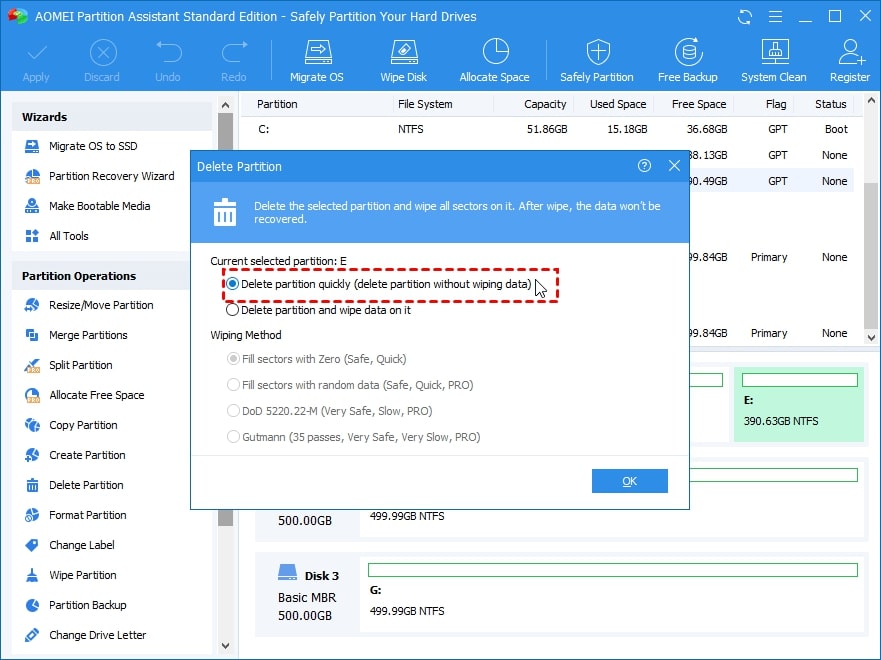
Step 2. Choose Delete partition quickly (delete partition without wiping data) and click OK.
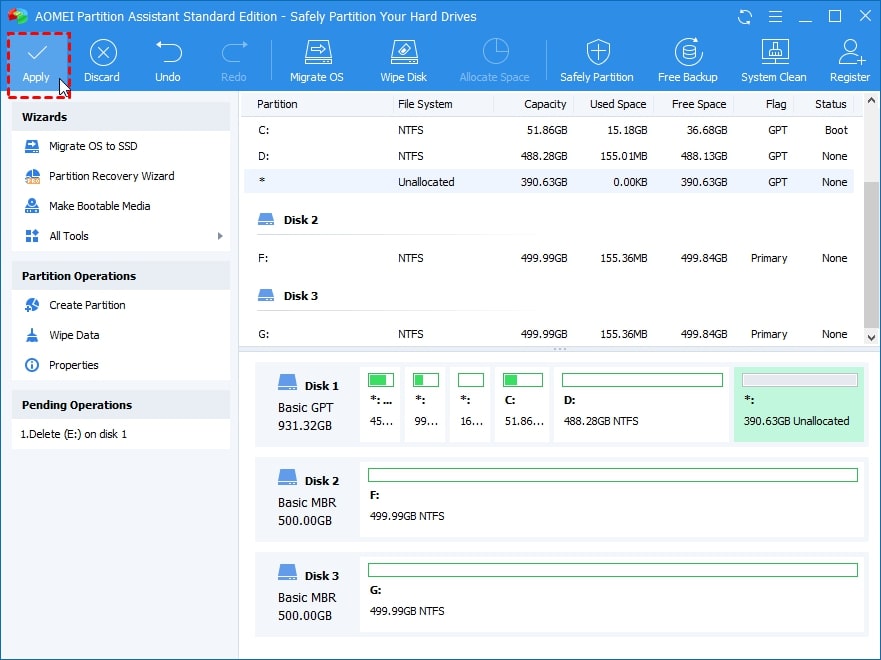
Step 3. Return to the main interface and click Apply and Proceed to complete the operation.
Tips/Notes:
- To delete the system partition, insert a USB into the PC, use the tool to create a bootable USB drive, reboot the PC, and enter BIOS to boot from the USB. Then you'll be in the main interface of AOMEI Partition Assistant Standard, where you can select "Delete Partition."
- AOMEI Partition Assistant Standard is free to use and can wipe partitions and hard drives. You can also upgrade to AOMEI Partition Assistant Professional to securely wipe SSDs.
- AOMEI Partition Assistant Standard is compatible with Windows 11/8.1/8/7, XP, and Vista.
Bonus Tips: How To Recover Deleted Partitions on Windows and Mac
All of the methods mentioned above will erase the data on the partition. Before you begin, you must have a backup of your important data.
If you lost data without backup, no worries. Wondershare Recoverit allows you to recover deleted or lost partitions entirely and quickly. Selected as the leader in data recovery by users on G2, it is a powerful and easy-to-use partition recovery software that can help you recover partitions and restore your data quickly in no time.
Feature |
Benefit |
Lost Partition Scan  |
Finds partitions even after the partition table is wiped. |
| Raw Recovery | Retrieves data from "Unallocated Space" directly. |
| Preview Mode | Verify your files before committing to recovery. |
Wondershare Recoverit: An Excellent Partition Recovery Software
5,481,435 people have downloaded it.
Retrieves deleted, lost, or damaged FAT16/32, exFAT, NTFS, APFS, HFS, HFS+, HFSX, and Linux Ext2/3/4 partitions efficiently.
Recovers data from 2000+ storage media, including computer hard drives, external hard disks, USB flash drives, SD cards, digital cameras, etc.
Supports data recovery from 500+ data loss scenarios, such as accidental deletion, formatting, hard drive corruption, virus attack, system crash, and lost partition.
Wondershare Recoverit: Storage Partition Scannability Array
Storage Partition Layout |
Raw File System File Trees |
Specialized Sector Recovery Engine |
Core Performance Action |
| Unallocated Disks | NTFS, FAT16/32, exFAT | Lost Partition Reconstruction Engine | Bypasses missing volume boundaries to locate data footprints directly within the raw disk architecture. |
| Apple Storage Volumes | APFS, HFS, HFS+, HFSX | Native macOS Storage Block Mapping | Resolves unreadable structural data errors on external drives moved between Windows and Mac host environments. |
| Open Source Environments | Linux Ext2, Ext3, Ext4 | Cross-Platform Extent File Indexer | Extracts complex multi-layered data archives from local NAS setups or dual-boot system arrangements. |
| Raw Sector Degradation | 2000+ Hardware Media Profiles | Bad Sector Fragment Splicing | Reasssembles fractured storage blocks into coherent, complete files even when the primary drive controller is failing. |

The steps below will show you how to recover a deleted partition in Windows. The guide structure for recovering deleted partitions on Mac is the same.
Step 1. Select the Lost Partition
If you have deleted or lost a partition, Recoverit will detect it when the software is launched. As a result, you can begin scanning by selecting the Lost Partition option under Hard Drives directly.

Step 2. Scan the Partition
Recoverit lost partition recovery software will begin scanning for data from deleted partitions.

Step 3. Preview and Recover
The recoverable data will display on the screen during the scanning. You can filter and preview your desired files. Then, click Recover to save them to a safe location.

For Windows XP/Vista/7/8/10/11
For macOS X 10.10 or later
Summary
With this comprehensive guide, you now understand how to fix the issue when you cannot delete partitions on Windows 11/10. If you want to delete partitions on Windows 11/10 quickly and easily, AOMEI Partition Assistant Standard is a better option. But if you are confident enough to execute commands, use DiskPart.
Before deleting partitions, it is vital to back up data. Wondershare Recoverit will assist you in recovering deleted partitions in both Windows and Mac operating systems in case you skipped the backup process.
Post-Fix Checklist: Restoring Storage Volume Layout Stability
- Verify Partition Boundaries in Disk Management: Confirm that the space from your deleted partition is correctly marked as Unallocated Space inside the Windows Disk Management window.
- Execute Main Volume Extension: Right-click your primary or adjoining partition (such as the C: drive) and select Extend Volume to merge the newly freed space into your active file structure.
- Verify Sector Alignment (SSD/NVMe): If you utilized third-party partition utilities, run Windows PowerShell and execute the command Get-PhysicalDisk | Select DeviceId, Size, Mechanical to confirm that your solid-state disk sectors are correctly aligned for peak performance.
- Re-enable Virtual Memory Allocation (Pagefile): If you had to disable your system pagefile to delete a locked partition, go back into Advanced System Settings and set your virtual memory to System Managed on your primary drive.
- Set Up a Resilient Local Backup Strategy: To protect your structural partitions from accidental future wipes, schedule an automated weekly system image save onto an isolated external drive.
For Windows XP/Vista/7/8/10/11
For macOS X 10.10 or later


