 TL;DR:
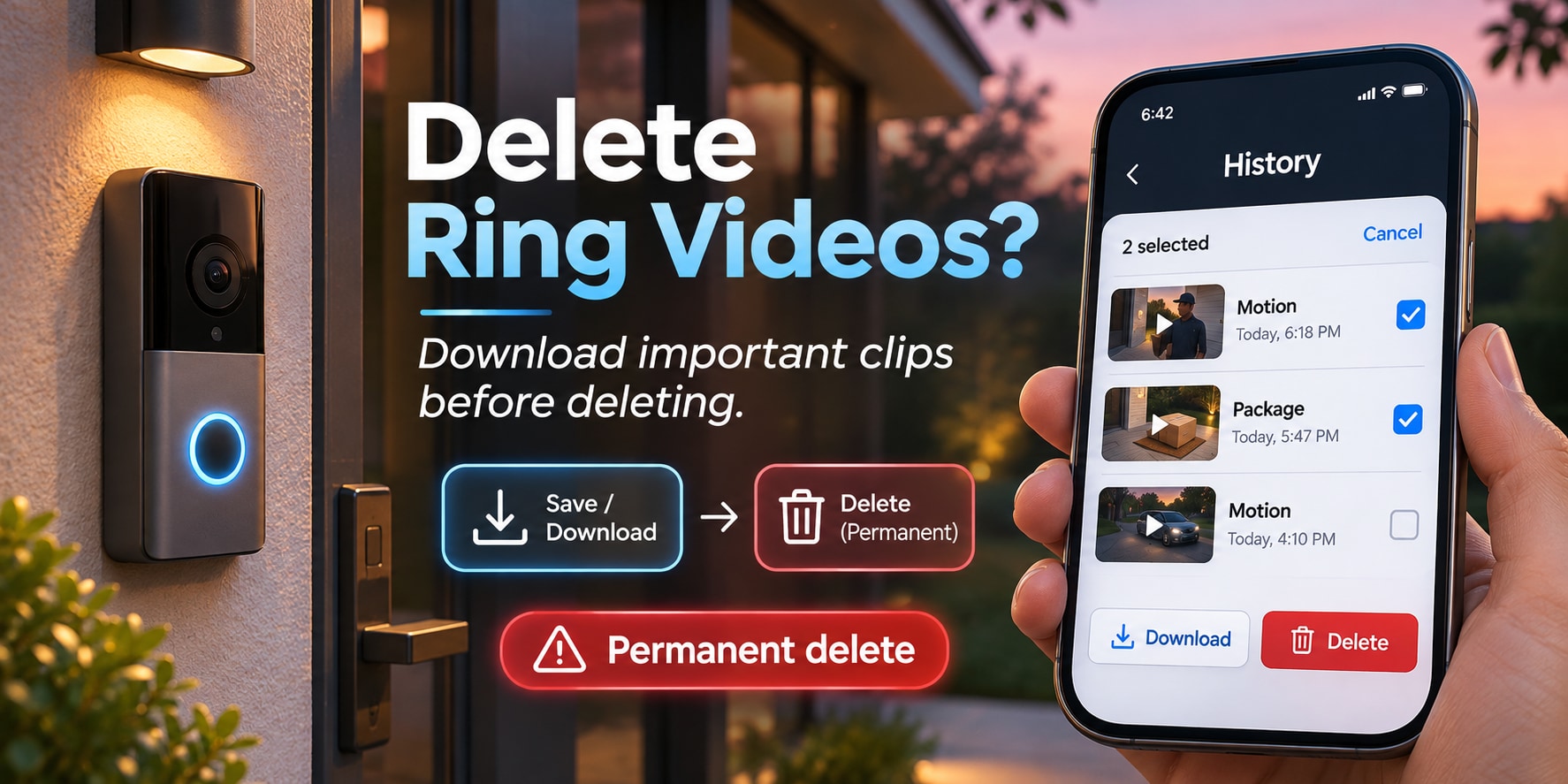
Authorized Ring account owners can permanently delete single, multiple, or all recorded clips via the History menu in the Ring app or Ring.com, while eligible 24/7 Recording cameras require using the device timeline to erase specific time segments.
● Deleting footage from the Ring cloud is irreversible and does not automatically revoke access to previously shared links, which must be manually unshared using Ring's shared-video controls.
● Ring Edge recordings stored on an Alarm Pro microSD card cannot be read directly as MP4 files on a computer and must be accessed or exported exclusively through the Ring interface.
● Data recovery tools like Wondershare Recoverit cannot restore events deleted from Ring servers; they can only scan for previously downloaded MP4 files lost from a local Windows or Mac drive.
Ask AI for a summary
 ChatGPT
 Perplexity
 Gemini
 Claude
 Grok
Quick answer: Yes. If you own the Ring account, open History in the Ring app, tap the pencil icon, select one or several recorded events (or Delete All), and confirm Delete. On ring.com, use History > Manage. Eligible cameras using 24/7 Recording have a different timeline that can delete an event or a time segment. Ring video deletion is permanent. Save an important clip first; deleting a private event also does not automatically revoke a previously shared link.
In This Article
Part 1. What to Know Before Deleting Ring Footage
Start by identifying the recording, the account that owns it, and whether it is an event clip or continuous footage. A motion alert in Event History does not always mean a video was recorded; Ring requires an eligible subscription or trial for saved event videos. Deleting an event, revoking a shared link, and erasing a downloaded MP4 are different actions.
Can You Delete Ring Videos and Who Can Do It?
Ring account owners can delete their saved videos. Ring's privacy guidance states that Shared Users cannot delete videos or change device settings. If the delete control is missing, make sure you are signed in as the authorized account owner and viewing an available recording, rather than repeatedly reinstalling the app.
Choose the action that actually matches your video source:
| What you want to do | Where to go | What to expect |
| Delete one recorded motion or doorbell event | Ring app History or Ring.com History | Remove only the selected saved event |
| Delete several event clips | History > pencil icon or Manage | Remove the selected recordings |
| Delete all available event clips | Ring app History > Delete All | Bulk deletion cannot be undone |
| Delete a 24/7 continuous-video interval | Eligible camera's 24/7 Timeline | Remove an event, 15 minutes, an hour, or the entire day |
| Stop access to a previously shared video link | Unshare in Ring's shared-video controls | The shared copy is handled separately from the private recording |
| Keep a clip for a claim or incident | Download before deleting | Keep and verify a separate original file |
| Manage Ring Edge local recordings | Ring app or Ring.com via Alarm Pro | Do not assume its microSD can be read as MP4 files on a PC |
Deleting, Unsharing, and Downloading Are Different Actions
Delete removes an account video permanently. Unshare removes access through a previously created share link without deleting the original private recording. Ring explicitly warns that deleting a private video does not automatically unshare it; unsharing may take time to finish. A previously downloaded or independently forwarded file is a separate copy. Follow Ring's official video management instructions.
Download first if the footage matters. In Ring's app, open History, find the event, tap More (...), then Download. On Ring.com, select recordings in History > Manage and choose Download. Browser downloads can arrive as timestamped MP4 files inside a ZIP archive. Open the saved file to confirm the camera, date, audio, and playback before deleting the Ring event.
To unshare a video: In the Ring app, go to Control Center > Video and Snapshot Storage and manage Shared Videos; on Ring.com, use History > Shared Videos > Manage, choose the link and confirm Unshare Video. Do this separately from deleting footage, especially if privacy is your reason for removal.
Evidence caution: If the recording concerns a theft, accident, dispute, or insurance claim, keep a verified copy before making an irreversible change. If necessary, follow applicable legal or organizational retention requirements.
Part 2. How to Delete Ring Videos in the Ring App
For ordinary motion and doorbell clips, Ring's current app instructions use History and the pencil icon. Cameras with 24/7 Recording enabled have a timeline-specific deletion menu; choose the correct workflow before proceeding.
Delete One Ring Video or Selected Events
Step 1. Open the Ring app and tap History on the main dashboard. Find the recorded event. Confirm its device name, date and timestamp; do not rely on a similar-looking thumbnail alone.
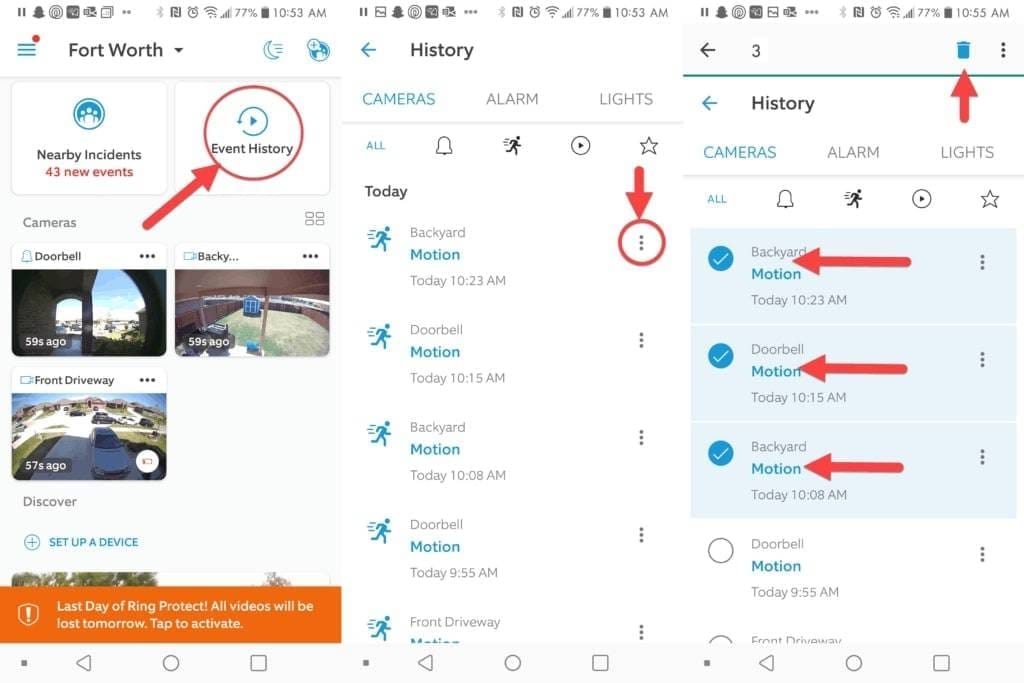
Step 2. Tap the pencil icon at the top right of History. Check one event, or select several events you want to remove.
Step 3. Tap Delete, then Delete again to confirm. Return to History and check that the selected event is no longer available.
If the video is missing before you delete it: A motion or doorbell event can appear in History without a playable video. Verify that the applicable recording subscription was active when the event occurred. Software cannot recover a recording that was never created.
Delete All Ring Videos at Once
Step 1. From the Ring app dashboard, tap History and then the pencil icon.
Step 2. Choose Delete All rather than selecting individual event checkboxes. Make sure you intend to remove all available videos in the selected History view.
Step 3. Review the confirmation carefully and tap Delete twice. Deleted recordings cannot be retrieved from Ring's cloud account history.
Do not use Delete All to solve a recording problem: It neither repairs a disconnected camera nor restores expired videos. Use storage-time settings if your goal is to control how long future clips are retained.
Delete a Segment of 24/7 Ring Recording
Use this method only if your eligible, continuously powered Ring camera has 24/7 Recording enabled with the applicable subscription. Its 24/7 Timeline is not the same as the ordinary History event list. Ring's available options include an individual event (about one minute), 15 minutes, 1 hour, or Entire day.
Step 1. From the Ring app dashboard, tap the relevant camera preview. If Live View opens automatically, select End Live to see the timeline.
Step 2. Move the 24/7 Timeline to the date and moment you want to remove. Double-check the starting point before choosing a duration.
Step 3. Tap More (...), then Delete. Choose Selected Event, 15 minutes, 1 hour, or Entire day, as offered by your current app.
Step 4. Confirm Delete. A gap should appear in the timeline where that continuous video was removed.
On Ring.com, open the camera's 24/7 Timeline, select Manage, choose the event or available time range, and delete it. Ring's 24/7 Recording guide has the latest menu details.
Before choosing a large time range: You can save up to 10 minutes from a specific section of the 24/7 Timeline through the Ring app, but not necessarily the whole day in one file. Eligible continuous recordings are stored for up to 14 days; ordinary motion events can have a different storage period. 24/7 Recording is not available alongside Ring Edge microSD storage or optional end-to-end encryption on the same camera configuration.
Part 3. How to Delete Ring Footage on the Ring Website
Ring.com is useful for reviewing event clips on a larger screen or selecting several clips at once. Log in to the same authorized owner account associated with the camera.
Step 1. Sign in at ring.com and open History.
Step 2. Select Manage (pencil icon), choose the video to delete, or use Select Multiple for several events.
Step 3. Select Delete and confirm Yes. Return to History to confirm the intended recording was removed.
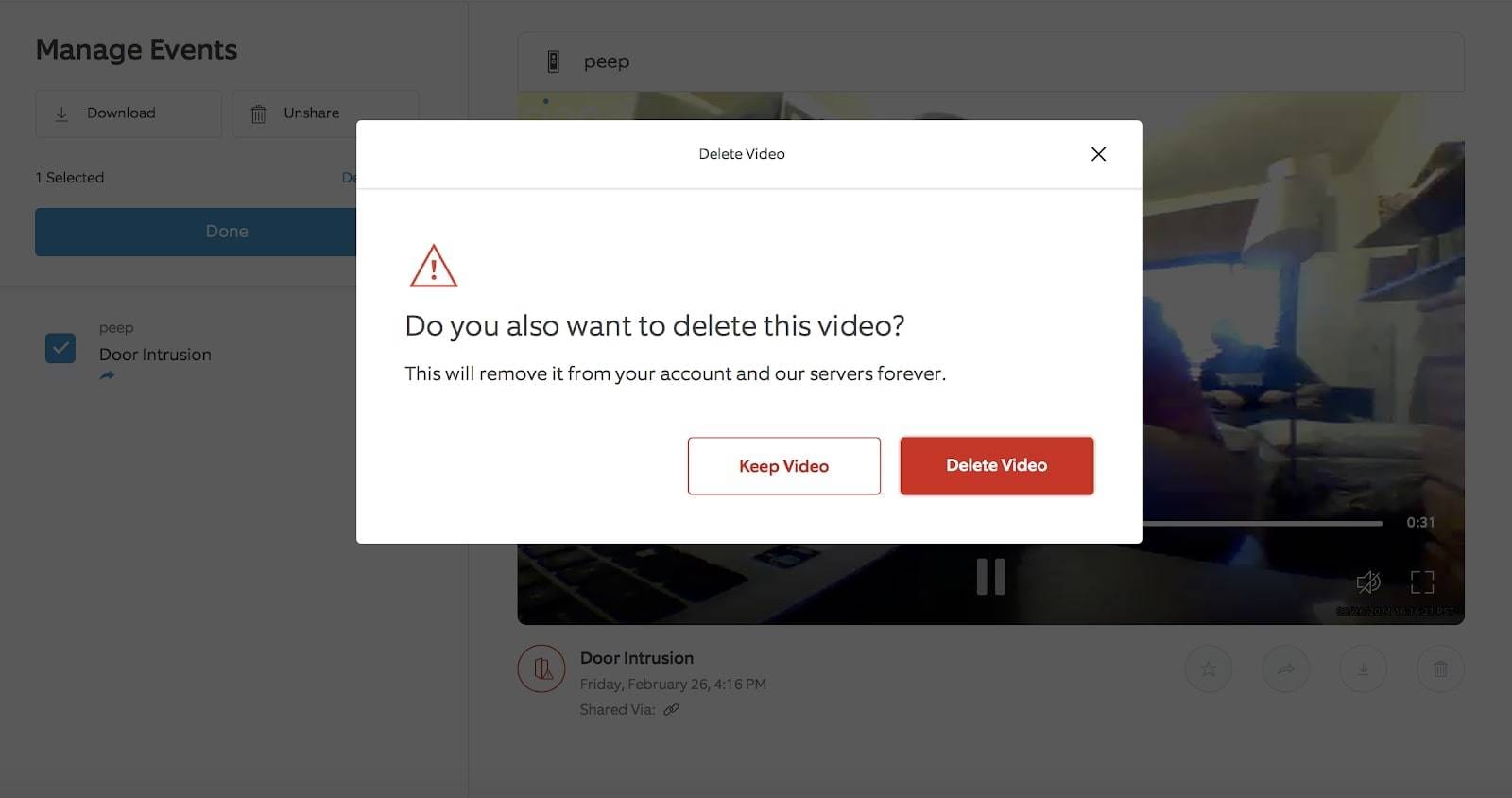
For continuous recordings: Use the separate 24/7 Timeline > Manage controls instead of the ordinary History event menu. Check the selected time range and avoid deleting an entire day unintentionally.
Note: The screenshot above depicts the Ring website's deletion confirmation; menu positions may have changed since it was captured. Follow the labels in Ring's current instructions if your screen differs.
Part 4. What Happens After You Delete Ring Footage?
Ring treats deletion as permanent and irreversible for the account's stored footage. It does not supply a recycle bin for a deleted event. The crucial distinction is which copy disappeared: a Ring cloud event, a separately shared video link, an exported MP4, or a Ring Edge recording held by Alarm Pro.
Can Deleted Ring Videos Be Recovered?
Not from Ring's cloud after you delete them. Signing in on another phone, changing storage duration, or scanning a computer with data recovery software cannot restore an event already removed from Ring's cloud history. If you unshared a video, the private original may still exist; if you deleted the private original, a separately shared link may need to be revoked as well.
Event videos with an applicable Ring subscription can be retained for up to 180 days, subject to settings and region. The Ring video storage-time guide also makes clear that changes apply to new recordings, not to videos that have expired or been deleted. Eligible 24/7 continuous video has a shorter limit of up to 14 days. Neither limit means that every account has that amount of history.
If you are trying to restore a lost Ring recording rather than delete one, see the related guide to checking whether any separate Ring video copy survives. There is no guaranteed support-side recovery window for deleted Ring cloud events.
How to Check an Independent Downloaded Copy
Step 1. Check your phone's Photos or Files app, your computer's Downloads folder, saved ZIP files, external drives, and any backup you control. The recording must have been downloaded or copied before the Ring event was deleted to count as an independent copy.
Step 2. If you find a downloaded video, extract the ZIP if necessary and play its MP4 files. Verify the timestamp, camera, audio, and full playback before treating it as evidence or deleting anything else.
Step 3. If the MP4 was saved on a Windows or Mac drive but later deleted, stop saving new data to that source. First check the Recycle Bin, Trash, or a valid backup. Only then consider a local recovery scan, and save any recovered file somewhere else.
What If You Use Ring Edge With Alarm Pro?
Ring Edge is a different storage workflow: compatible cameras can record to a microSD card inside the Ring Alarm Pro base station. Ring says these recordings must be viewed or downloaded using the Ring app or Ring.com, not opened directly as ordinary video files by plugging that microSD card into a PC. Optional card encryption further restricts access.
If a Ring Edge recording seems missing, check the correct account and device in the Ring app, the Ring Edge connection, and any existing exported copy before disturbing the card. Do not format, initialize, unregister, or attempt to decrypt the card as a first recovery step; those actions can make video data inaccessible. Ring's Ring Edge explanation and microSD requirements describe these limits. Ask Ring Support about access issues.
Important: Ring Edge's microSD is not an appropriate direct target for a generic 'recover deleted MP4' tutorial. A separate MP4 exported to a normal computer drive is a different and potentially recoverable file.
Part 5. Recover a Deleted Local Copy With Recoverit
Only follow these steps if you had already downloaded a Ring video to a Windows or Mac computer, a connected USB drive, or other ordinarily readable local storage and that independent file was deleted afterward. Wondershare Recoverit does not access Ring cloud servers, undo account deletion, or read Ring Edge's protected video library directly.
Step 1. Protect the original drive. Stop downloading or saving new files to the storage device where the MP4 was lost. Connect it safely to the computer, launch Recoverit, and select the correct drive or original folder, following the current product interface.
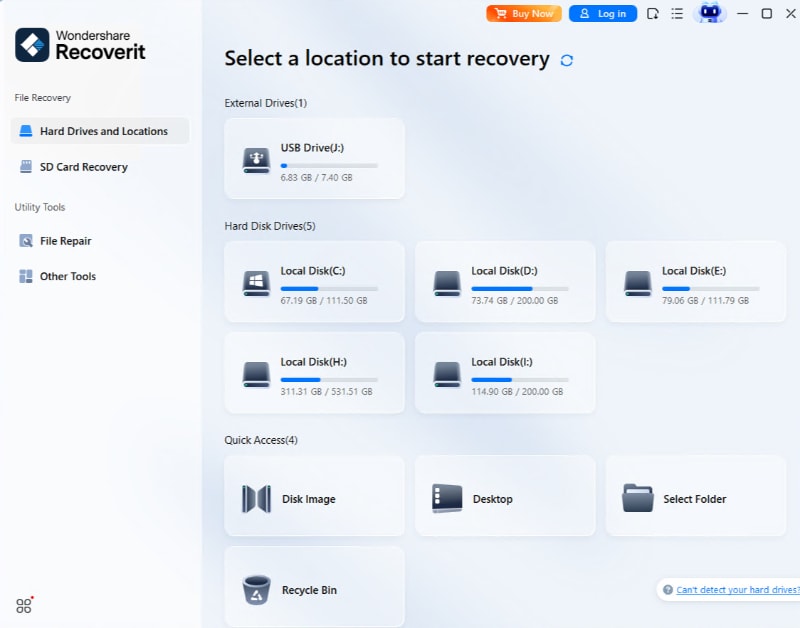
Step 2. Scan and review the results. Let Recoverit scan the selected location. Check video files by name, size, type, date, and any available preview. A found file or preview does not prove that the complete recording can be restored.
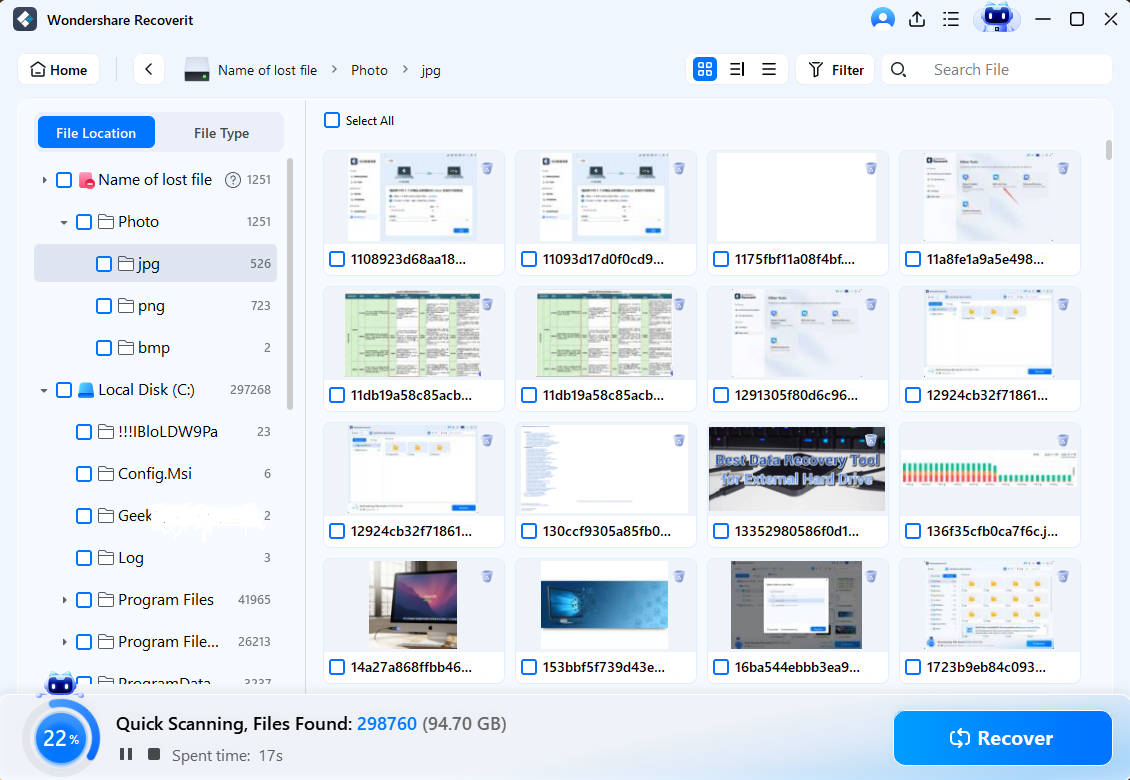
Step 3. Recover elsewhere and verify playback. Select any plausible Ring MP4 and save recovered files to a different healthy drive, never the scanned source. Open the saved file to confirm its length, audio, and video. Success depends on whether the original data remain; overwritten or flash-storage-trimmed files may be unrecoverable.
See the official Wondershare Recoverit guide for up-to-date Windows/Mac workflows and available preview steps. If a drive is physically failing or repeatedly disconnects, stop DIY scans and seek a qualified professional.
Conclusion
To delete Ring camera footage, an authorized account owner can use History in the Ring app or Manage on Ring.com for individual or multiple recorded events. For eligible 24/7 Recording cameras, use the separate timeline to remove a specific event, 15 minutes, one hour, or an entire day. Save important clips before deletion, and unshare public links separately. Ring cloud deletions cannot be reversed; only independent copies, such as a downloaded MP4, can be evaluated for local file recovery.
FAQ
-
Can you delete Ring camera footage permanently?
Yes. Ring account owners can delete saved videos in the Ring app or on Ring.com. Ring states that video deletion is permanent and irreversible. Keep a verified copy first if you may need it. -
How do I delete all Ring doorbell footage?
Open History in the Ring app, tap the pencil icon, choose Delete All, then confirm Delete twice. Do not confuse this with deleting the camera, changing retention settings, or removing only a shared link. -
If I delete Ring footage, does it delete for everyone?
Deleting an account recording removes it from Ring's saved history rather than only your phone's view. But exported copies may remain elsewhere, and previously shared links must be unshared separately to revoke that access. -
Can a Ring shared user delete my videos?
No. Ring's published privacy guidance says Shared Users can view recordings but cannot delete videos. The account owner must handle deletion. -
How do you delete part of a 24/7 Ring recording?
On an eligible camera with 24/7 Recording, open its timeline, move to the starting moment, select More and Delete, then choose the event, 15 minutes, one hour, or Entire day. Verify the selected interval before confirming. -
How long does Ring keep recorded videos?
Eligible Ring event videos can be retained for up to 180 days, depending on the subscription, device, and storage setting. Continuous 24/7 footage is retained for up to 14 days. Changing a setting does not restore clips already deleted or expired. -
Can I open Ring Edge microSD recordings on a PC?
No, not as ordinary video files. Ring says Ring Edge videos stored in Alarm Pro are accessible through the Ring app or Ring.com; optional microSD encryption restricts direct access further. Export a supported copy through Ring's interface instead of formatting the card. -
Can Recoverit restore deleted Ring videos?
Not when they were deleted from Ring's cloud. If a separate MP4 had already been downloaded to a readable local computer drive and was later deleted there, Recoverit may help assess whether any data remain. Recovery cannot be guaranteed.


