
NOR flash memory is a type of non-volatile semiconductor memory used for firmware, boot code, configuration settings, and other data that must survive a power-off. It is especially useful for low-latency random reads. With a suitable interface and processor, NOR can also support execute-in-place (XIP), which lets code run directly from flash instead of first being copied into RAM.
The NOR chip that holds a device's startup instructions is not the same thing as the USB drive that holds your documents. Most USB flash drives, SD cards, and SSDs use NAND for their bulk storage. That distinction matters when you compare memory specifications—or try to recover lost files.
In This Article
Part 1. What Is NOR Flash Memory?
NOR is one of the two main flash memory architectures, alongside NAND. The name comes from the NOT OR logic operation: the arrangement of the memory cells resembles a NOR logic gate. The cell architecture should not be confused with the chip's external interface; NOR is available with both serial and parallel interfaces.
Like other flash memory, NOR retains charge states without a continuous power supply, but it still needs power to read, program, or erase data. Non-volatile does not mean permanent: retention depends on the device, temperature, prior wear, and the manufacturer's specified conditions.
NOR is not SRAM. SRAM is a different memory technology commonly used for fast working memory; conventional SRAM loses its contents when power is removed. NOR is persistent storage that a system can use for code or data. For the broader distinction between memory technologies and finished storage devices, see how flash memory differs from RAM and drives.
Part 2. How Does NOR Flash Work?
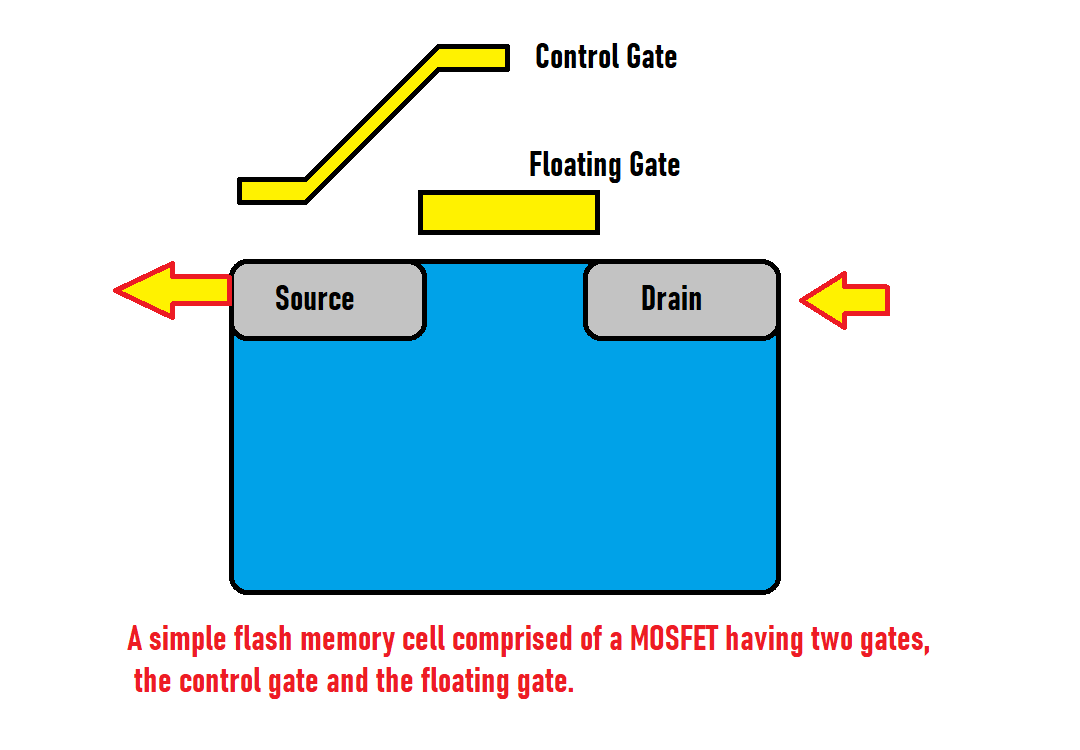
A flash memory cell stores information as an electrical charge state. Reading senses the stored state; programming and erasing change it. The cell structure and number of bits stored per cell depend on the design. A traditional floating-gate cell uses an insulated gate to retain charge, but that illustration does not describe every NOR implementation.
Read, Program, and Erase
Three operations explain why NOR behaves differently from ordinary working memory:
- Read: The device senses stored states and returns the requested data. NOR is well suited to retrieving small pieces of information at fine address granularity.
- Program: Controlled electrical operations change cell states to store data. The permitted program unit and alignment depend on the part and command.
- Erase: The device resets a sector, block, or larger region before it can be reused as required. Erase units are generally larger than individual addresses.
Programming a changed byte does not necessarily mean you can overwrite it arbitrarily without erasing surrounding storage. Software must follow the chip's program and erase rules and preserve other data in an affected erase region. The Linux SPI NOR documentation illustrates how device-specific parameters distinguish read, page-program, and erase operations.
Random Access and Execute-in-Place
Random access means the system can request data at a particular address rather than reading everything before it. Low-latency random reads make NOR useful for startup code and embedded applications. This does not make NOR equivalent to RAM, or guarantee that every NOR device is faster than every NAND-based device.
XIP allows a compatible processor to fetch instructions directly from mapped flash. It requires support from the memory interface, controller, and system design. Other systems copy code into RAM before executing it, a technique often called code shadowing. Winbond's W25Q-JV family describes both direct execution through compatible SPI interfaces and code shadowing.
Part 3. Serial NOR vs. Parallel NOR
Serial and parallel describe how the host communicates with the chip, not whether the internal cells are NOR or NAND. Both interface families can store firmware; the best choice depends on the processor, pin budget, access requirements, and the specific device.
Serial NOR and SPI Interfaces
Serial NOR commonly uses SPI, or Serial Peripheral Interface. Conventional SPI sends commands and data through a small number of pins. Dual, quad, and octal variants can use additional data lines to transfer more information per clock, where the chip and controller support the selected mode.
Serial NOR is therefore not necessarily a single-data-line-only device. Compare supported commands, clock rates, read latency, voltage, and XIP capability rather than assuming that “serial” determines performance. Micron's NOR product families include serial, octal, and parallel designs.
Parallel NOR and Data Bus Width
Parallel NOR uses address and data connections to communicate with a host. An x8 or x16 organization refers to the data bus width, not an eight-bit or sixteen-bit address bus. Capacity and the address connections must be checked separately in the device specifications.
For example, Infineon's S29GL064N90TFI040 is a 64-Mbit device with an 8-bit or 16-bit data bus. Its nominal capacity is 8 MB; selecting a 16-bit data organization does not double that capacity. This is a part-specific example, not a size limit for parallel NOR.
Part 4. Where Is NOR Flash Used?
NOR is particularly useful when a device needs persistent instructions or relatively small amounts of data that can be read quickly. Infineon's NOR overview identifies boot code, embedded systems, and XIP as important uses.
| Application | What NOR May Store | Why It Fits |
| Computer and device startup firmware | Boot instructions, BIOS/UEFI firmware, or related configuration | Persistent code and fast access during startup |
| Industrial and embedded controllers | Program code, settings, and small data records | Predictable access to code and configuration |
| Connected and consumer devices | Firmware, interface assets, or other small data | Compact code storage through a compatible interface |
A device can contain both architectures: a NOR chip may hold startup code while a NAND-based SSD or managed storage module holds user files. NOR is not limited to code, and NAND is not incapable of storing code. These are common design roles rather than rules for every product.
Part 5. NOR vs. NAND Flash Memory
The useful question is which access pattern the memory is designed to serve. NOR generally favors fine-grained random reads and direct code access; NAND generally favors dense bulk storage. Neither architecture is universally better.
| Characteristic | NOR Flash | NAND Flash |
| Typical role | Firmware, boot code, configuration, and small data | High-density file and bulk data storage |
| Read access | Fine-grained random reads | Typically page-oriented at the chip level |
| Program and erase | Part-specific programming; sector or block erase | Typically page programming and block erase |
| Code execution | XIP where the interface and system support it | Code is commonly loaded into RAM in storage-based systems |
| Density and cost per bit | Generally lower density and higher cost per bit | Generally higher density and lower cost per bit |
| Common examples | Firmware chips and embedded code storage | SSDs, USB flash drives, and SD cards |
Compare actual chips or finished devices for speed, endurance, and power consumption. A NAND-based USB drive's performance also depends on its controller and host interface, not just its cells. The NAND flash memory guide explains cell types, controllers, and storage endurance in more detail.
Part 6. How Long Does NOR Flash Last?
NOR has no universal ten-year lifespan. Two different specifications matter:
- Program/erase endurance: How many specified programming and erasing cycles the memory can tolerate under rated conditions.
- Data retention: How long stored information is expected to remain readable under the manufacturer's conditions, which can depend on wear and temperature.
A chip's retention rating is not a guarantee that the complete device will operate for that many years. Its power supply, board, package, connectors, or other components can fail independently. Likewise, a supplier's long-term product availability commitment describes supply, not how long your individual chip will last.
For a specific design, check the part's operating conditions, endurance, retention, and update requirements. Keep a verified backup of important configuration or data where the device supports it. Being solid-state means no moving storage parts; it does not make a chip or its circuit board immune to drops, water, or electrical damage.
Part 7. Can You Recover Data from NOR Flash?
First identify what is missing and how the storage is exposed to your computer. A damaged firmware image in an embedded NOR chip calls for a different approach from deleted documents on a USB drive. Do not erase, format, or reflash the source simply to test whether the data will return.
If Firmware or Configuration Data Is Missing
Check the device manufacturer's recovery documentation and any existing firmware or configuration backup. Match the exact model and revision before considering a recovery procedure. A firmware update may replace code without restoring your old settings or device-specific data.
If important data remains on the chip, preserve it before attempting operations that write to the device. Where you cannot safely access a backup, the device is physically damaged, or a recovery process requires chip-level work, stop and consult the manufacturer or a qualified specialist. Avoid generic programmer commands copied from a different chip.
A bare NOR chip is not automatically a drive that Windows or macOS can scan. Recoverit should not be treated as a SPI programmer, a BIOS repair tool, or a way to reconstruct erased firmware. Any claim about software support for an unusual NOR-based storage device requires verification of that device's actual host interface and supported data format.
If Files Are Missing from a USB Drive or SD Card
Most consumer USB drives and SD cards store files in NAND, even though they are commonly called “flash memory.” If your computer can reliably detect the device and the missing files have not been overwritten, file recovery software may be relevant. This is a file-recovery scenario, not evidence that the software can access raw NOR chips.
- Protect the source: Stop saving new data to it. Check existing backups and copy any files that are still accessible to a different healthy device.
- Check eligibility: Use the appropriate supported-storage workflow only if the source is consistently detected. If it repeatedly disconnects, shows signs of physical damage, or cannot be detected reliably, stop repeated scans and seek professional advice. A detected drive with an unreadable file system is a different case; follow the relevant recovery guide without formatting it.
- Scan, preview, and save elsewhere: Recoverit can scan compatible computer-accessible storage for recoverable files and preview supported results. Save recovered files to another healthy drive, then open them to check that they contain the data you need.
The official Recoverit guide describes supported workflows and excludes overwritten files and physically failed storage from ordinary software recovery. A successful scan or preview does not guarantee that every file will be recovered intact. For a complete USB workflow, follow the USB flash drive file recovery guide; for cards, see SD and memory card recovery.
Conclusion
NOR flash is persistent memory designed for fast random access to code and small amounts of data. Serial and parallel interfaces offer different ways to connect it, while actual speed, endurance, and retention depend on the part and system. When data is missing, distinguish firmware in a NOR chip from files on a computer-accessible drive before choosing a recovery approach.
FAQ
-
What Does NOR Stand For in Flash Memory?
NOR means NOT OR. NOR flash is named for a cell arrangement that resembles the NOR logic operation; the name does not identify a connector or file system. -
Is NOR Flash the Same as SRAM?
No. NOR is non-volatile flash storage, while conventional SRAM is volatile working memory. Random-read access does not turn NOR into SRAM. -
Can NOR Flash Be Erased and Reprogrammed?
Yes, within the part's program/erase rules and rated endurance. Whether the chip holds firmware or other data does not determine whether ordinary flash cells are programmable. Check the specific device documentation before attempting to change its contents. -
Do SD Cards and USB Flash Drives Use NOR?
Most consumer SD cards and USB drives use NAND for bulk file storage. A device may also contain other memory for its controller, but the word “flash” alone does not mean its files are stored in NOR. -
Does Serial NOR Support Execute-in-Place?
Some serial NOR parts support direct code execution through compatible interfaces and controllers. Check the specific chip and system requirements; other designs copy code into RAM first.


