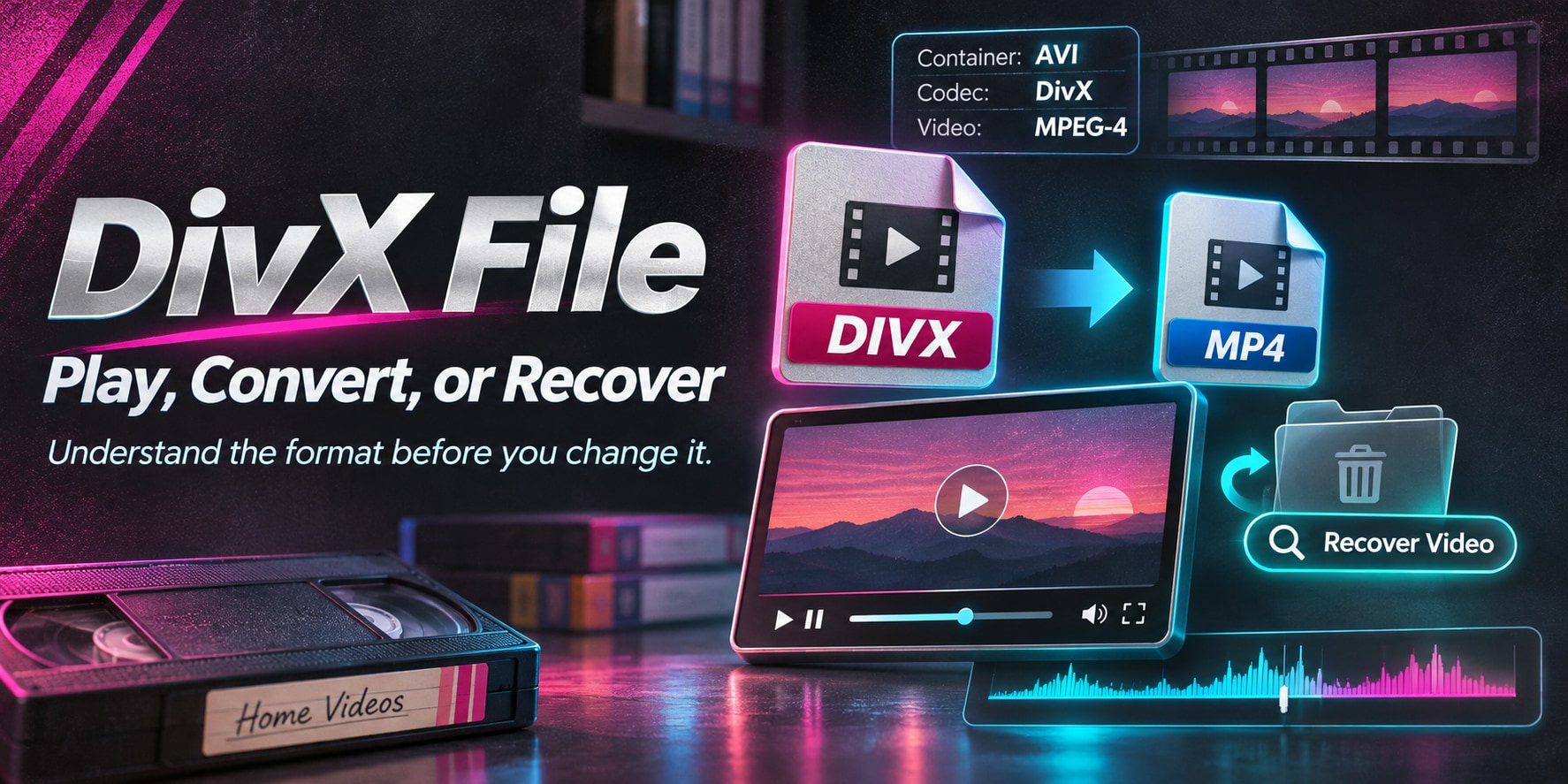
A DivX file usually means a video encoded with the classic DivX codec, often stored in an AVI container or a file ending in .divx. DivX also names a broader software and certification family, so a DivX label alone does not tell you every codec inside a file or which television will play it.
Start by separating three questions: what the file contains, whether your player can decode it, and whether you need a different format. For an owned, unprotected video, try compatible playback before converting. For a modern sharing copy, H.264 video with AAC audio in MP4 is a practical target; for older DivX hardware, the device's supported profile matters more than the output filename.
Quick choice: If the file is present but will not play, try a current VLC build first. If it plays but another device rejects it, check the codec and convert a separate copy for that device. If the original video has disappeared, stop using the source drive and check backups before considering recovery.
In This Article
Part 1. What Is DivX Video Format?
The most useful definition separates the codec, the container and the playback certification. They describe different parts of the same video workflow.
DivX Codec, File Extension and Container
A codec describes how video or audio is compressed and decoded. A container organizes those streams into a file. Classic DivX video uses MPEG-4 Part 2 compression; .avi and .divx are file extensions you may encounter around that video.
The classic .divx media format is AVI-based, rather than a promise that every file contains identical audio or picture settings. DivX's AVI technology explanation describes AVI as a container supporting different codecs. The later DivX Media Format introduced with DivX 6 added features such as menus, chapters, subtitles and alternate audio tracks.
This distinction explains why a converter can preserve the main picture and soundtrack yet lose a menu or an extra language track. It also explains why changing movie.divx to movie.mp4 does not turn its video into H.264. For the container itself, see the separate AVI format guide.
Classic DivX, DivX HD and DivX Plus HD Are Not Interchangeable
The word HD describes a resolution class, not one universal decoding requirement. In particular, DivX HD and DivX Plus HD should not be treated as two spellings of the same profile.
| Label or File | What to Identify | Compatibility Decision |
| Classic DivX; AVI or .divx | MPEG-4 Part 2 video and its audio codec | Check the player's supported resolution, frame rate and encoding features. |
| DivX Media Format / Ultra features | Menus, chapters, subtitles and multiple audio tracks in addition to the main movie | Basic video playback does not prove that all interactive features work. |
| DivX HD | The exact HD profile and maximum dimensions stated by the device | Do not assume that the label means H.264, HEVC or 4K support. |
| DivX Plus HD | H.264 video in MKV, with the supported audio configuration | Requires the corresponding profile support, not merely an older DivX logo. |
DivX's Plus HD documentation specifically describes H.264 video and AAC audio in MKV. It is a historical profile explanation, not a current guarantee for every device. A newer codec generation does not retroactively upgrade an older player.
DivX software itself is still available. The official version history lists DivX Software 11.16 for Windows and Mac, released September 30, 2026. On Windows, version 11.16 requires Windows 10 or later; Windows 7 users need to consult the vendor about an earlier supported release. DivX Media Server was removed from 11.16, so upgrading will not restore that feature on a legacy streaming setup. These software changes do not alter the codec profiles accepted by older TVs or DVD players.
DivX Compared With MP4: Quality and File Size
Comparing DivX with MP4 without naming the codecs mixes two different concepts. MP4 can hold several kinds of video; it does not always mean H.264. DivX's own MP4 glossary makes this container-versus-codec distinction.
Neither label guarantees a particular compression ratio. Size depends mainly on duration, video and audio bitrates, and overhead. As a rough calculation, a 10-minute file at a combined 2 megabits per second contains about 150 megabytes of media data before container overhead. Upscaling an old DivX movie does not restore detail that was discarded during earlier compression.
Xvid video is another MPEG-4 Part 2 implementation you may find in an AVI library. Inspecting the actual stream is more reliable than treating every AVI file as DivX or assuming that all similarly named files are compatible.
Part 2. How to Identify and Play a DivX File
Keep the original unchanged and work with a complete local copy. A cloud placeholder, incomplete transfer or protected purchase needs a different response from a normal video that opens in the wrong application.
Identify the Container and Codecs
This method is useful when a file's extension is unclear or a device reports an unsupported format. It requires FFmpeg, including ffprobe, installed from a trusted distribution. These commands read the input; they do not repair or overwrite it.
Step 1. Open Terminal, PowerShell or Command Prompt in the folder containing your copy. Use the actual filename in quotation marks. Confirm that ffprobe -version runs before continuing.
Step 2. Read the container, streams and duration with the following command. The ffprobe documentation explains the selectable fields and output formats.
ffprobe -v error -show_entries format=format_name,duration -show_entries stream=codec_name,codec_type,codec_tag_string,profile -of default=noprint_wrappers=1 "legacy-sample.divx"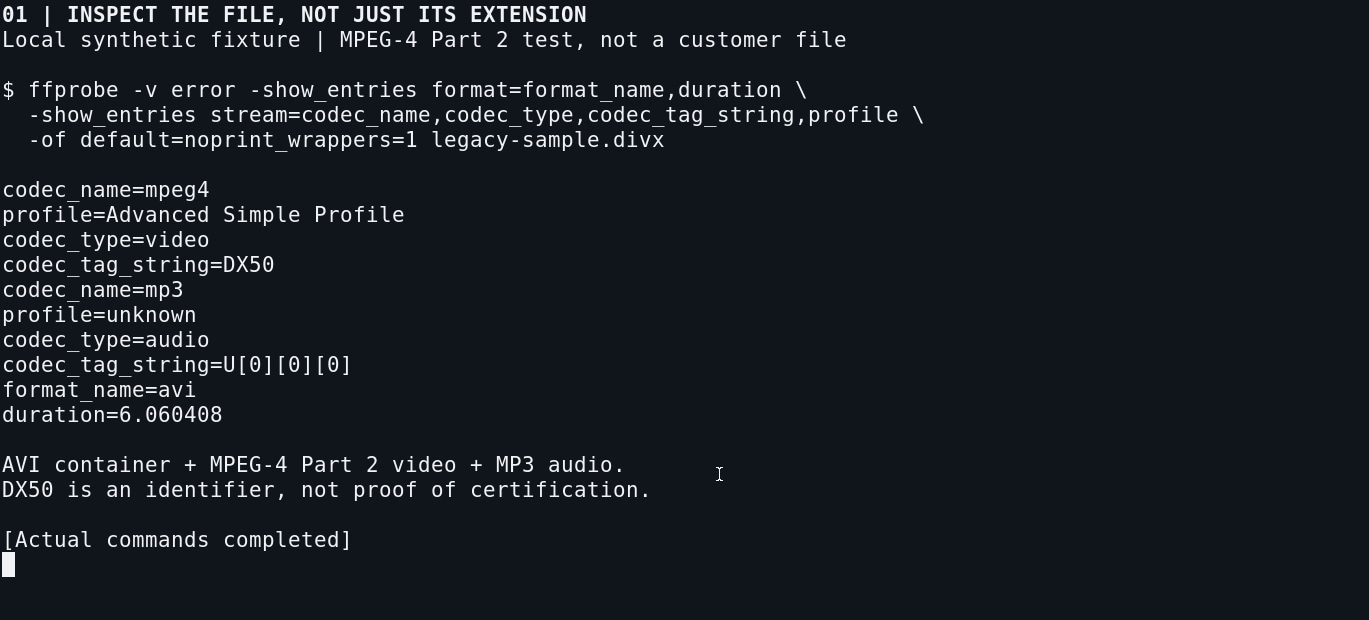
Step 3. Interpret the fields together. format_name=avi identifies the container; codec_name=mpeg4 indicates MPEG-4 Part 2, not H.264. An audio result such as mp3 identifies a separate stream. A tag such as DX50 is an identifier, not independent proof that an encoder or device passed DivX certification.
A readable report is useful evidence, but it does not prove that the entire movie decodes. If ffprobe cannot read the file, verify its size and compare it with the original copy. A zero-byte or truncated file cannot be fixed simply by selecting a different extension.
Open an Unprotected DivX Video in VLC
For ordinary local playback, start with a current player rather than installing several system-wide codec packs. VideoLAN describes VLC as a free, cross-platform player with broad media-format support; broad support is not a guarantee for encrypted or damaged files.
Step 1. Install the appropriate VLC edition from VideoLAN or its official app-store listing. Choose the iOS edition for iPhone or iPad, not an Android application. Keep a known-good video available for comparison.
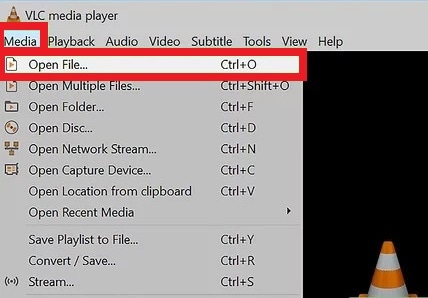
Step 2. On Windows or Linux, choose Media > Open File and select the video. On macOS, use File > Open File, or drag the local file into VLC. On a phone, open the downloaded copy in the VLC app rather than relying on a browser's preview.
Step 3. Check the beginning, middle and end. Confirm that seeking works and that the intended audio and subtitle tracks are available. A movie that plays without menus may still contain optional DivX features that this playback path does not expose.
If the same video plays in VLC but not on a television, focus on the television's supported profile. If every video fails in VLC, investigate the application rather than converting the whole library. For a file-specific failure, the symptom checks for DivX playback problems help distinguish decoding trouble from damaged media.
DivX Software is another vendor-supported option on compatible Windows and Mac systems. A browser, phone gallery or legacy Windows Media Player installation is a different playback environment; installing a desktop codec does not automatically add support to all of them.
Part 3. How to Convert DivX to MP4
Conversion is appropriate when the original is readable but the destination needs a different codec or container. Preserve that original: transcoding makes a new version, and it may not retain menus, chapters, every soundtrack or all subtitles.
Create an MP4 Copy With HandBrake
HandBrake is a graphical option for converting an unprotected DivX video to a modern MP4 copy. It is not the reverse solution for every old DivX player: HandBrake's documented output containers are MP4, MKV and WebM, not a legacy AVI or proprietary .divx export.
Step 1. Install HandBrake from its official site, choose Open Source, and select the video. Wait for the source scan, then confirm the detected title and duration. The official source-opening instructions also cover dragging a video into the application.
Step 2. Select an appropriate preset, then set Summary > Format to MP4. A preset is a starting point, not proof of compatibility. For an ordinary SDR sharing copy, check for H.264 video and AAC audio, and avoid enlarging a low-resolution source unnecessarily.
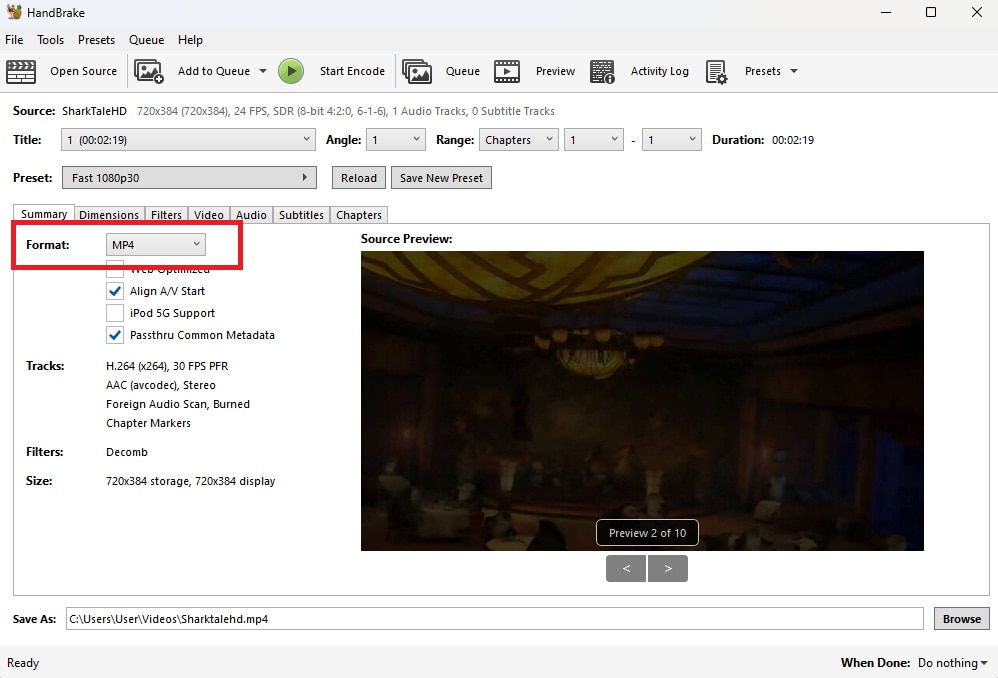
Step 3. Review Dimensions, Video, Audio and Subtitles. Preserve the display aspect ratio and intended language tracks. Choose a frame-rate setting appropriate to the source and target instead of assuming that 30 fps is always correct. Preview a short section with motion, speech and subtitles before committing a large batch.
Step 4. Enter a new .mp4 output name in Save As, choose a different output path, and click Start Encode. A setting near RF 20 can be a starting point for an x264 test, not a universal optimum; adjust after inspecting detail and compression artifacts.
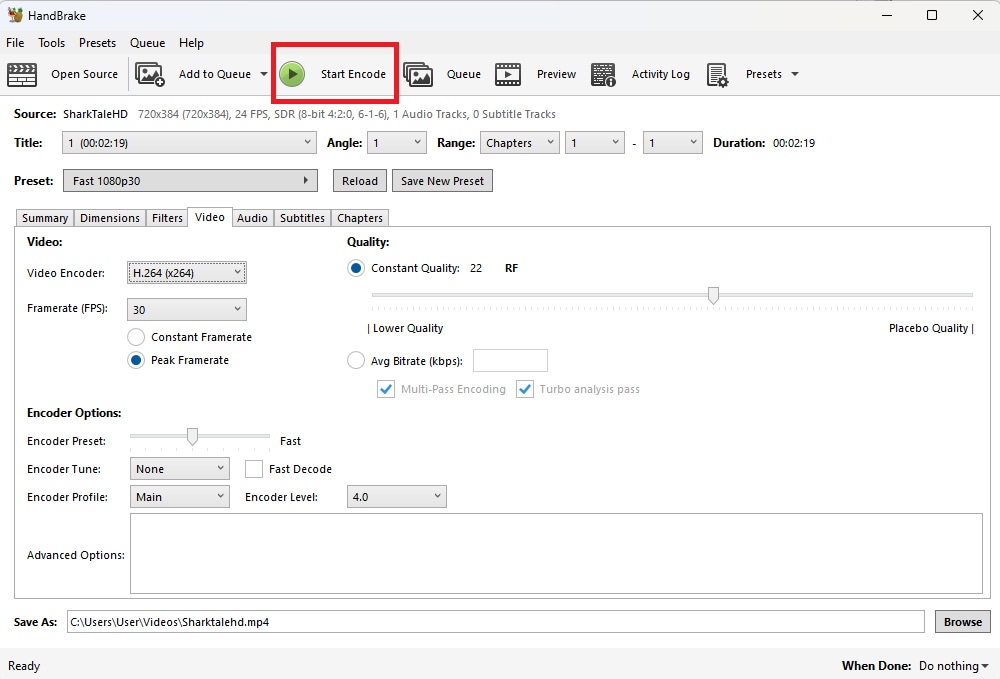
Step 5. Open the completed MP4 in the intended player. Compare duration, aspect ratio, dialogue synchronization and subtitles with the source. Do not delete the original merely because the conversion queue says it finished.
If the source cannot be scanned, inspect the activity log and try a complete original copy. If a device rejects the result, investigate the codec and profile it actually accepts. The container documentation is particularly useful when a tutorial incorrectly treats MP4, AVI and .divx as interchangeable output choices.
Convert DivX to H.264 and AAC With FFmpeg
Use this approach when you need explicit codec settings or a repeatable conversion command. The example targets ordinary SDR video; HDR, unusual color formats and interlaced sources require additional decisions rather than blind reuse of one preset.
Step 1. Confirm that FFmpeg can read your copy and that the build includes the required encoders. Run the following as one line, replacing the input and output names. -n prevents accidental overwriting of an existing output file.
ffmpeg -n -i "legacy-sample.divx" -map 0:v:0 -map "0:a:0?" -c:v libx264 -crf 20 -preset medium -pix_fmt yuv420p -c:a aac -b:a 192k -movflags +faststart "modern.mp4"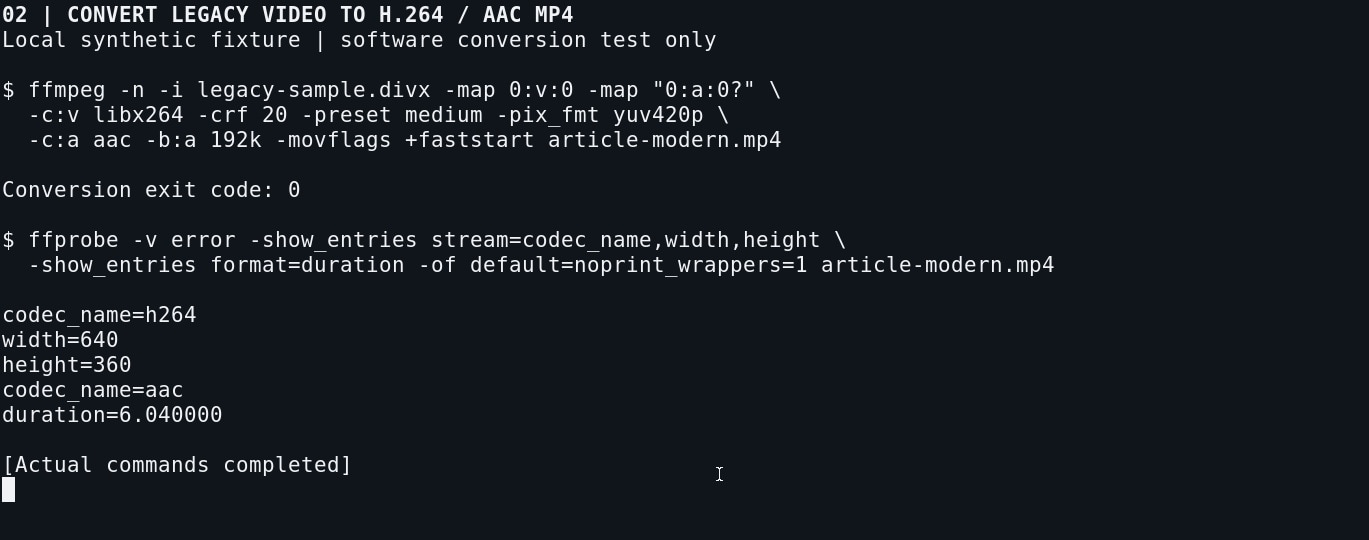
Step 2. Understand the selections before batching. The maps select the first video and, when present, the first audio stream. They do not promise to carry every language, subtitle, chapter or menu. libx264 re-encodes the video, aac re-encodes audio, and +faststart relocates MP4 playback metadata for progressive access.
Step 3. Probe the output, play it, and compare several positions with the original. A complete decoding check is also useful:
ffmpeg -v error -i "modern.mp4" -f null -This check does not replace viewing the picture or testing the destination device. If an encoder is unavailable, install a suitable trusted build; if decoding reports errors at the same point, inspect the input rather than repeatedly increasing the quality setting.
FFmpeg's stream-copy and transcoding documentation explains why -c copy is a different operation. Copying a classic MPEG-4 Part 2 stream into MP4 does not turn it into H.264. Remuxing may help a container-only mismatch, but cannot resolve a missing decoder on the destination.
Part 4. How to Convert MP4 for an Older DivX Player
The reverse direction is not symmetrical. An older player asking for DivX may need MPEG-4 Part 2 in AVI, while a newer DivX Plus HD device accepts a different profile. Start with the exact model's manual, not a generic converter button.
Make and Test a Legacy MPEG-4 Part 2 AVI Copy
This method creates a compatibility candidate, not a certified DivX Media Format file. It is suitable only when the device documentation accepts the resulting MPEG-4 Part 2 video, audio and container combination.
Step 1. Record the device's permitted container, video profile, dimensions, frame rate, bitrate and audio formats. Check USB filesystem and file-size limits separately. Do not format a drive containing your only copy to solve a video-decoder problem.
Step 2. For a source already within those limits, create a short test copy. This example was exercised on a 640 x 360, 25 fps SDR sample; it does not automatically reduce a 4K source to a legacy device's limits.
ffmpeg -n -i "modern.mp4" -map 0:v:0 -map "0:a:0?" -c:v mpeg4 -q:v 4 -bf 0 -vtag DX50 -c:a libmp3lame -b:a 128k -ac 2 -ar 44100 "legacy-test.avi"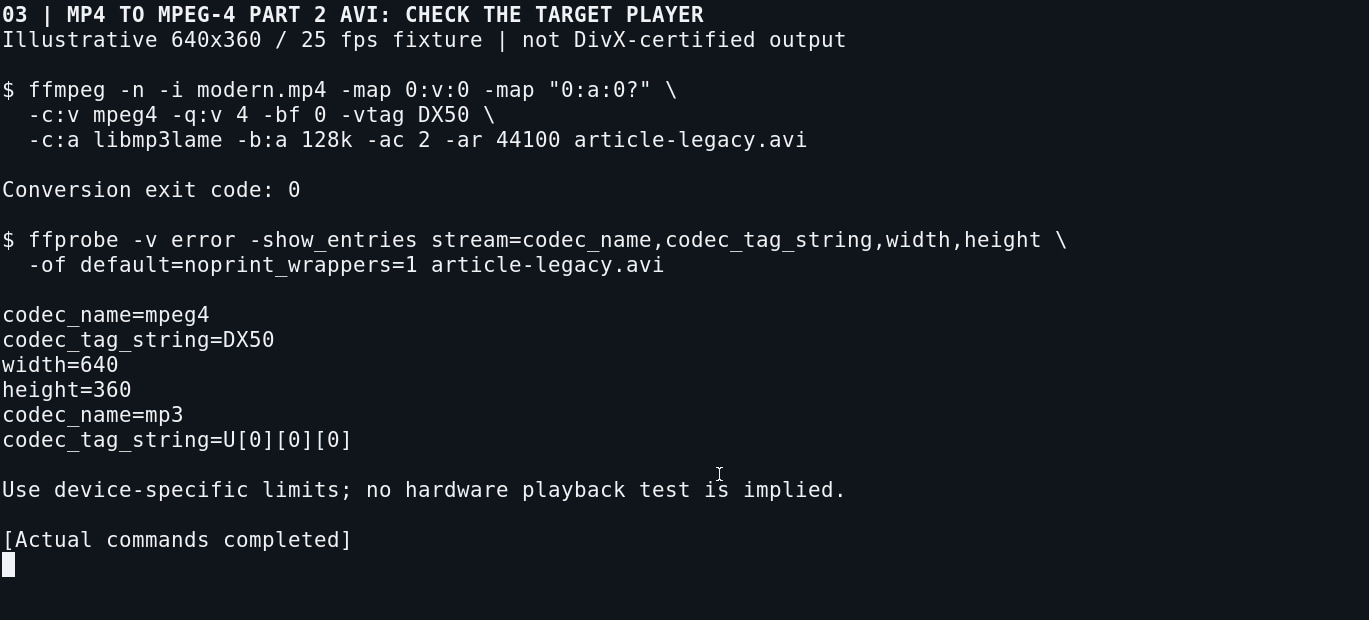
Step 3. Verify the output with ffprobe, then test it on the actual device. The native mpeg4 encoder makes MPEG-4 Part 2 video, while -vtag DX50 writes a stream identifier. It does not invoke a proprietary DivX encoder or grant certification. The codec documentation describes the available encoder options.
Step 4. Adjust only the constraint that the manual or test identifies. For example, the quality-based -q:v 4 setting does not enforce a strict bitrate ceiling; a device with such a ceiling needs suitable rate-control settings. Use appropriate resizing while preserving aspect ratio when dimensions are too large. Test again before converting a full collection.
If you specifically need .divx menus or a certified profile, use an encoder and profile documented for that device and software version. Renaming the AVI is not certification. If the target instead supports H.264 MP4, keep the modern copy and avoid an unnecessary additional lossy conversion.
A reproducibility check on November 5, 2026, used a six-second synthetic test pattern and tone with FFmpeg 7.1.5 on Debian Linux. The DivX-tagged AVI input, H.264/AAC MP4 output and MPEG-4 Part 2/MP3 AVI output all decoded without errors and each contained 150 video frames. This verifies the commands on that test sample; it does not verify playback on a particular DVD player or television, proprietary DivX certification, or preservation of every original feature.
Part 5. What to Check When a DivX Video Still Will Not Play
A failed playback attempt is a symptom, not a diagnosis. Use the pattern below to avoid treating permissions, codec limits and missing media as the same problem.
| Observed Result | Most Useful Next Check |
| Works in VLC, fails on a TV or car player | Compare the file's streams with that model's supported profile, audio and storage limits. |
| Picture works, sound does not | Check the selected audio track and audio codec; video conversion alone may not address it. |
| Only one file fails, while other files work | Compare size and duration with the original; incomplete transfer and input damage remain possibilities. |
| A purchased video requests registration or authorization | Follow the content provider's official supported playback route; a converter is not a license fix. |
| The file has disappeared from its storage location | Stop writes, check backups and consider recovery before converting anything. |
DivX's current version history says purchased DivX VOD content can be played only with DivX Software 11.0.1 or earlier. The separate VOD support notice gives background on that restriction. If a licensed video asks for authorization, contact DivX or the content seller for an approved route; neither renaming the file nor transcoding it replaces the required license. Consider security risks before installing unsupported older software.
For ordinary unprotected media, unsupported video format errors can arise from a codec or encoding setting even when the file is intact. Save the exact error and compare with a known-good file before declaring corruption.
Part 6. How to Recover a Deleted DivX Video
Recovery is relevant when the original video is actually missing from a computer drive, memory card or external storage device. A visible file that needs a decoder, a protected purchase or an unsupported television profile does not require a deleted-file scan. Recoverit lists DIVX and AVI among its supported video file types, but format support does not guarantee that a deleted file remains recoverable.
Find the Lost Original and Save It to Another Drive
Check the Recycle Bin or Trash, backups and any original source device first. Stop recording, downloading or converting onto the affected storage. Software recovery depends on the device being detectable and the missing data not having been overwritten.
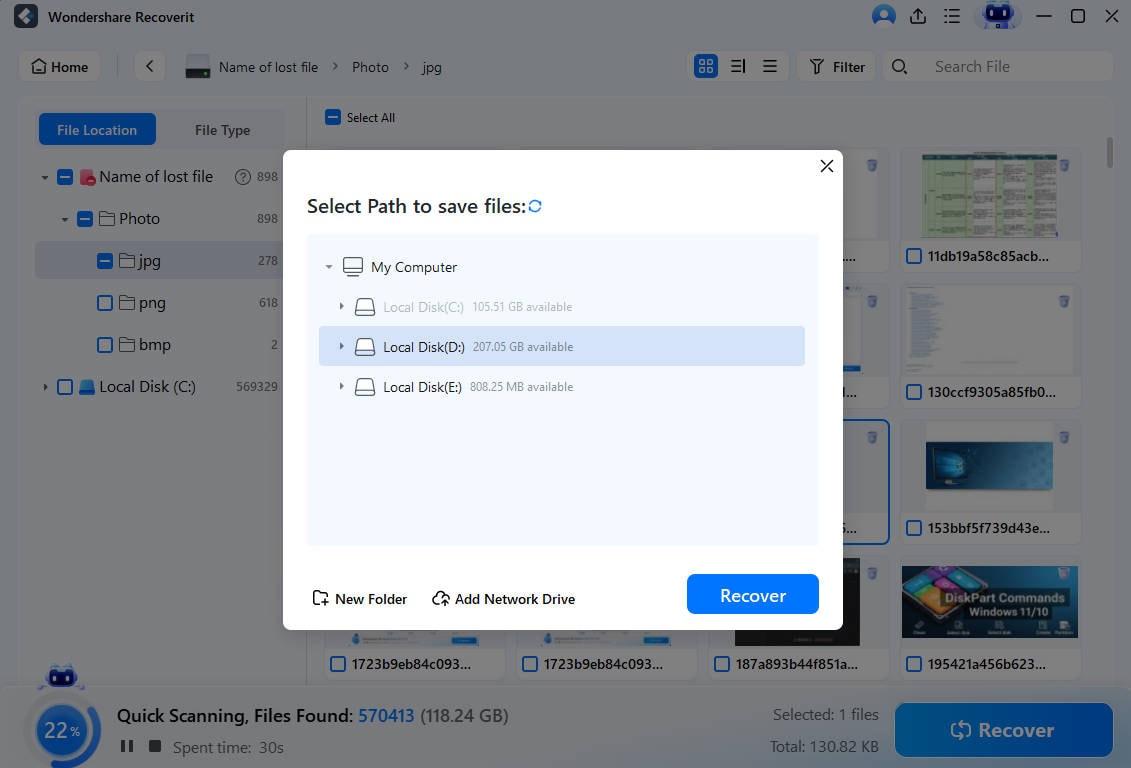
Step 1. Connect a healthy destination drive with sufficient free space. Install recovery software somewhere other than the affected drive where practical. A drive that repeatedly disconnects or shows physical-failure symptoms needs specialist assessment rather than repeated scans.
Step 2. In Wondershare Recoverit Video Recovery, select the storage location that held the missing video. Select the source device, not the destination that will receive recovered files.
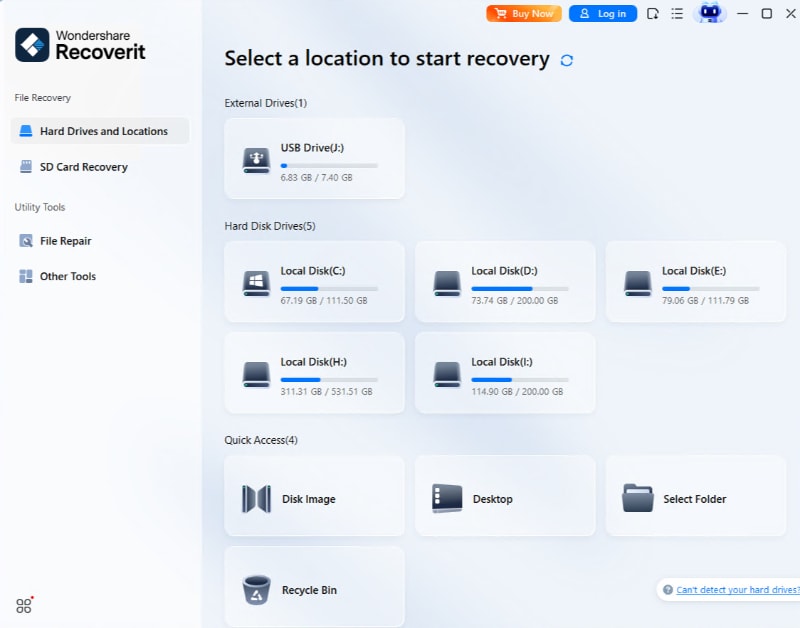
Step 3. Scan the selected location and inspect the results. Look for .divx and .avi candidates when they are available, and compare names, sizes and any supported previews. A filename or preview alone does not establish that the entire video is intact.
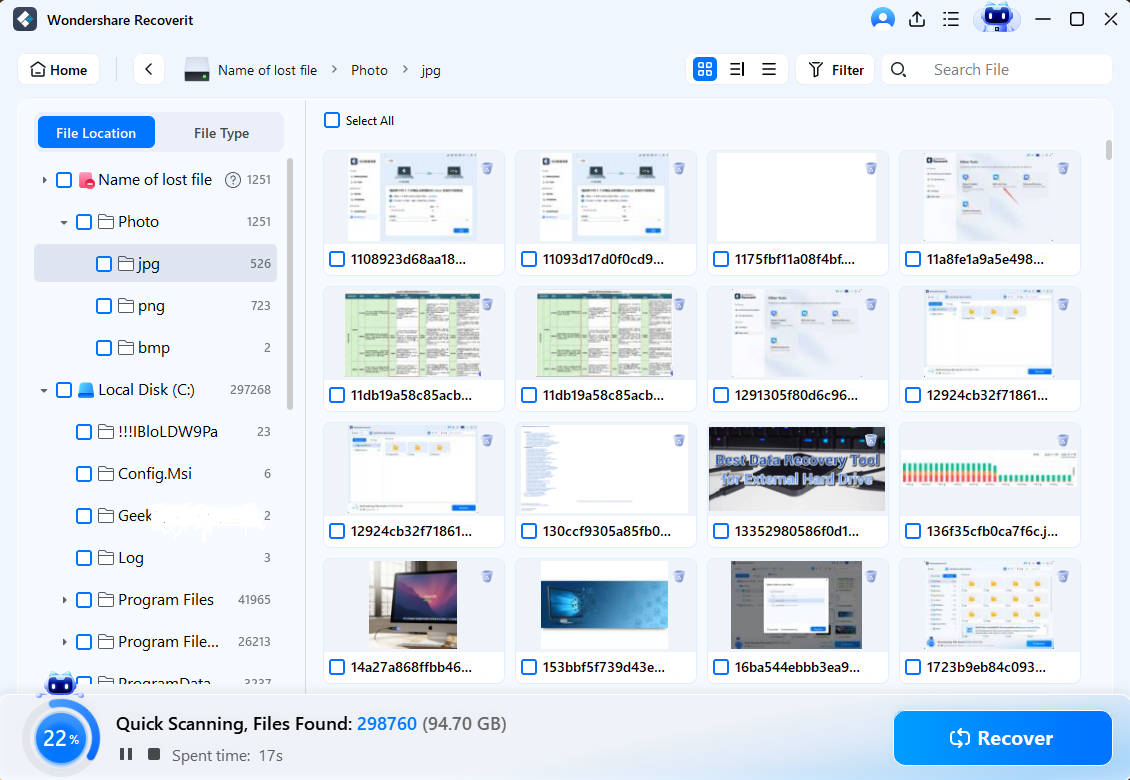
Step 4. Recover selected files to the different healthy destination. Open the recovered copy in a compatible player and verify its content, duration and audio before attempting conversion. The official Recoverit Windows guide explains location selection, scanning and saving.
No tool can guarantee recovery after overwriting or physical media failure. If the recovered video is incomplete, preserve it and check another source or backup; conversion does not manufacture the missing frames or restore a content license.
Conclusion
A DivX label is only the beginning of the compatibility check. Identify the container and codecs, try a compatible player, and convert only for a specific target. DivX to MP4 and MP4 to a legacy DivX-capable player require different settings, and a renamed extension does not bridge that gap. Keep the original, verify the new copy, and reserve recovery software for a genuinely missing file.
FAQ
-
Is DivX the same as AVI?
No. AVI is a container that can hold different codecs. Classic DivX video is often stored in AVI, while .divx can identify an AVI-based media format with additional features. Inspect the streams rather than inferring the codec from the extension. -
Is DivX still available?
Yes. DivX's official release history lists current software updates. An old codec-based movie, a current DivX application and a purchased VOD title have different compatibility requirements; the continued availability of software does not remove content authorization restrictions. -
Can I convert MP4 to DivX with HandBrake?
Not when your target specifically requires a legacy AVI or .divx output. HandBrake makes MP4, MKV and WebM containers. It is useful for DivX-to-MP4 conversion, but the reverse legacy-device task needs a suitable encoder and verified target settings. -
Can I convert DivX to MP4 without losing quality?
A compatible stream-copy operation avoids re-encoding the selected streams, but it does not change their codecs or guarantee feature preservation. Converting classic MPEG-4 Part 2 into H.264 is a lossy transcode. Keep the source and inspect a sample before batching. -
Why does a DivX HD video fail on my DivX player?
The device may support a different generation or have lower resolution, bitrate or audio limits. In particular, DivX Plus HD uses a different profile from older MPEG-4 Part 2 playback. Compare the exact file properties with the model's manual. -
Does a DivX file give me access to free movies?
No. DivX describes video technology, not a movie subscription or permission to download copyrighted content. Use your own recordings or media supplied with authorization. A format converter does not remove purchase or licensing requirements.


