

 TL;DR:
To recover unsaved, lost, or deleted Notepad (.TXT) files, you can extract temporary cache files, use built-in Windows recovery tools if previously configured, or deploy third-party recovery software depending on how the data was lost.
● For unsaved files in Windows 11: Relaunch Notepad to automatically restore open tabs via the built-in session state manager, which saves cache files in `%LOCALAPPDATA%\Packages\Microsoft.WindowsNotepad_8wekyb3d8bbwe\LocalState\TabState`.
● For application or system crashes on older Windows versions: Manually navigate to `%localappdata%\Temp`, search for `.tmp` or `.txt` files sorted by the exact time of loss, and open them in Notepad to extract unwritten strings.
● For overwritten files: Right-click the file and select "Restore previous versions", which requires the Windows File History feature to be set up beforehand.
● For permanently deleted files: Use the native command-line tool Windows File Recovery (e.g., `winfr C: D:\NotepadRecovery /extensive /n *.txt`) or a third-party tool like Wondershare Recoverit for a raw data sector scan.
Ask AI for a summary
 ChatGPT
 Perplexity
 Gemini
 Claude
 Grok
Grok
Although not as sophisticated as Word, Notepad has been a go-to solution for decades for Windows users looking to write something down quickly without worrying about the text's structure or the document's layout.
Unlike Word, Notepad lacks Microsoft's AutoSave and AutoRecover features, making these quick notes especially vulnerable to accidental deletion and data loss. And as these .txt files often contain vital info, the problem becomes even more significant.
Nonetheless, solutions exist, and users can restore unsaved Notepad files in multiple ways. That's also the topic of our discussion, and today, we'll examine the various methods for Notepad data recovery.
🔍 Notepad Data Loss Diagnostic Matrix: Match Your Recovery Solution
Before attempting complex recovery sequences, identify your exact data loss type below to choose the method with the highest probability of data reconstruction:
| Data Loss Scenario | Data File State | Storage Location | Most Effective Recovery Method |
| Accidentally clicked "Don't Save" | Stored in volatile RAM; dropped on application exit. | Virtual Memory / Local App Cache | Check Windows 11 TabState or use Wondershare Recoverit Deep Scan. |
| Notepad App or OS Crashed | Cache written to local temporary swap partitions. | Windows %TEMP% directory | Extract unwritten strings from local .tmp` block locations. |
| Accidental "Shift + Delete" | File pointer removed; data clusters marked as unallocated. | Hard Drive Sector Tracks | Deploy Wondershare Recoverit to run a direct raw data sector recovery. |
| Overwritten existing text file | Previous sectors updated with new character strings. | Windows Volume Shadow Copies | Roll back data states via Windows File History or Previous Versions. |
How Notepad Files Usually Get Lost
Losing text files and documents is incredibly common, and dozens of culprits can be behind this issue. There's nothing to worry about in most cases, as there are solutions to almost any data loss situation, so let's dive right into these.
- Closing without saving – Clicking the X button and realizing you've forgotten to save can feel terrible. However, in these situations, your files are often recoverable from the Windows Temporary folder.
Starting with modern updates to Windows 11, the native Notepad application features a built-in session state manager that preserves content across accidental application closures. If you shut down your PC without saving, do not panic. Relaunch Notepad—it will automatically restore your open tabs from cache files stored in the hidden Windows path:
%LOCALAPPDATA%\Packages\Microsoft.WindowsNotepad_8wekyb3d8bbwe\LocalState\TabState
- Notepad application crashing – A system error can cause your Notepad app to crash in the middle of your work. However, the contents of your text file are still in the computer's memory, and your file should be recoverable from the Temporary folder.
- Windows system crashing – If your PC shuts down, there won't be any text file in the Temp folder, but you can still use a data recovery tool to restore lost Notepad files.
- Overwriting a vital text file – Making an editing mistake or accidentally saving changes over a critical text file is nothing to worry about when you've set up File History, as you can quickly restore a file's previous version.
- Accidentally deleting a Notepad file – While far worse than an unsaved Notepad file, a deleted one is still recoverable through the Recycle Bin and with Windows Backup or a professional data recovery tool.
- Viruses and malware – Malicious apps are a nuisance and can delete or corrupt your .txt files. However, Windows Backup and professional data recovery tools work well in these situations.
Whatever your data loss situation is, there's no need to panic, as data is often recoverable. You can browse these recovery methods below and pick the one that fits your situation.
If you are a Notepad++ user, you can learn how to unsaved files in Notepad++.
Universal Solution for Recovering Unsaved/Lost/Deleted Notepad Files
While unsaved, lost, and deleted Notepad files all require a different approach, universal solutions that can handle all three situations also exist. These come in the form of professional data recovery apps, and they can safely approach any of these situations, so let's immediately dive into a prime example of one.
Using Wondershare Recoverit
Whether you're dealing with lost, unsaved, or deleted Notepad files, Wondershare Recoverit has your back. This universal recovery solution is perfect for restoring accidentally closed notepad files without saving. It also works to recover unsaved notepad files after restart and shutdown.
Recoverit is a reliable recovery tool when you face data loss caused by system crashes, viruses, malware, interrupted file transfers, failing disk drives, and 500+ other situations.
Using Wondershare Recoverit is remarkably simple, and here's everything you'll need to do to recover lost, unsaved, or deleted Notepad data with it:
- Launch the app, click Hard Drives and Locations, and select the disk drive where you store Notepad files.

Alternatively, right-click a folder with your .txt files and select the "Scan for deleted files with Recoverit" option.
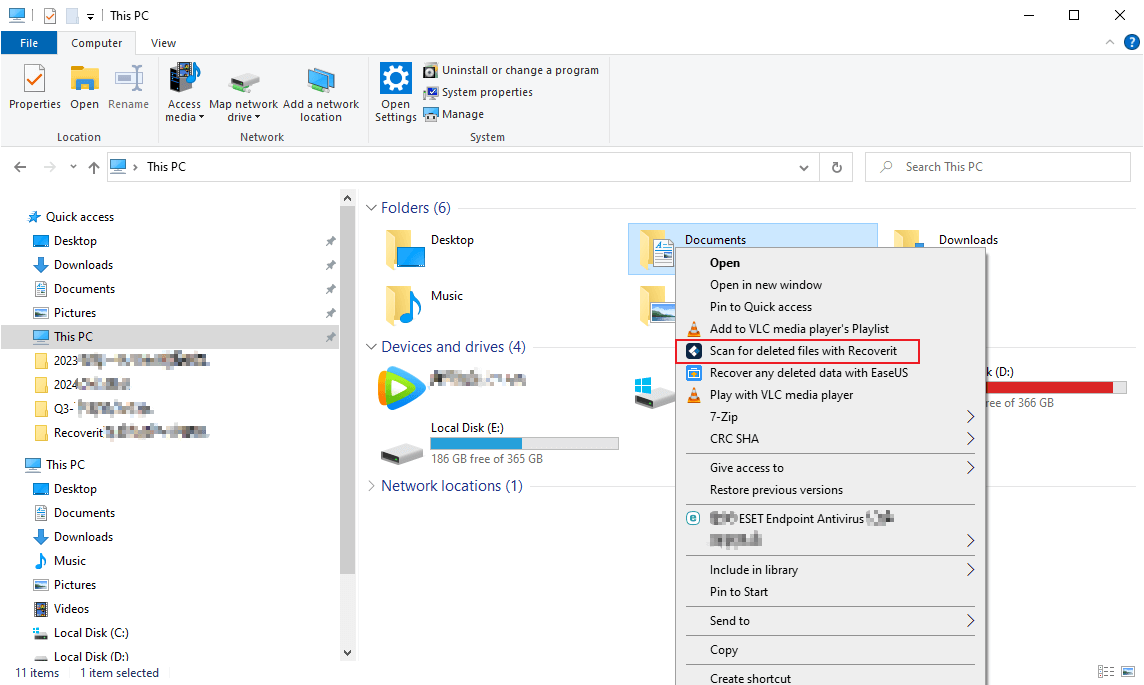
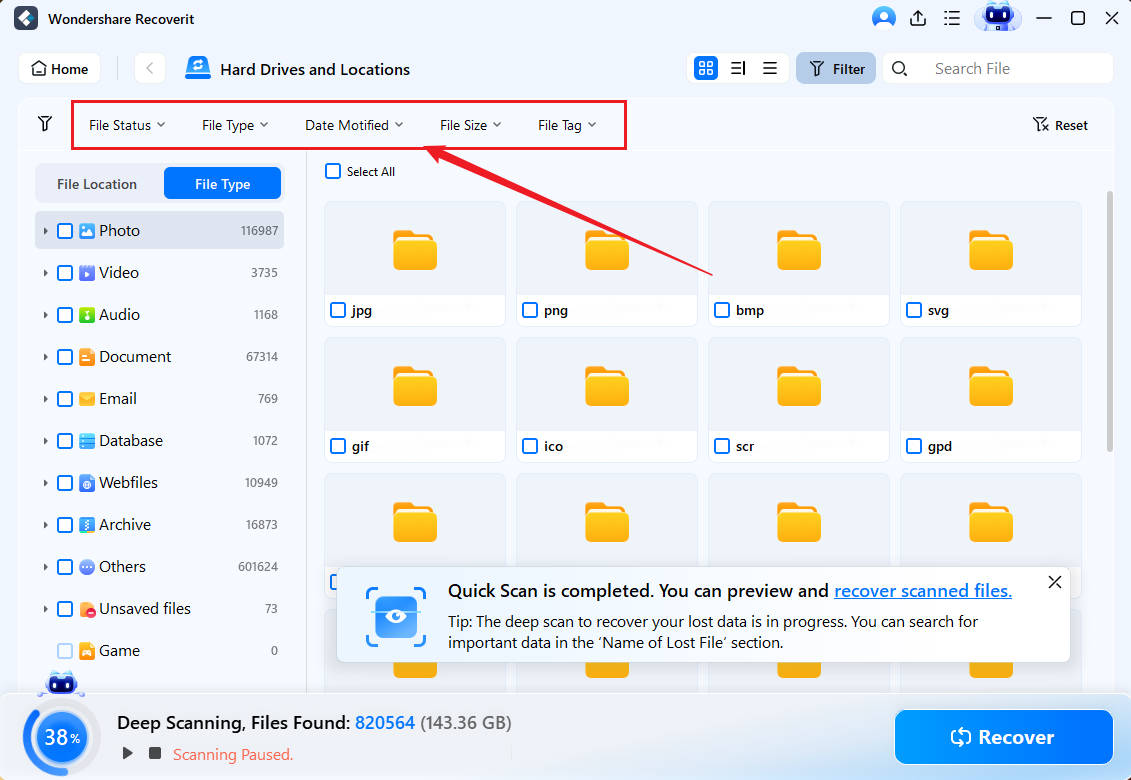
- The app will automatically start scanning the drive for lost files.

- You can then pinpoint the app's scan using various file filters and keywords.
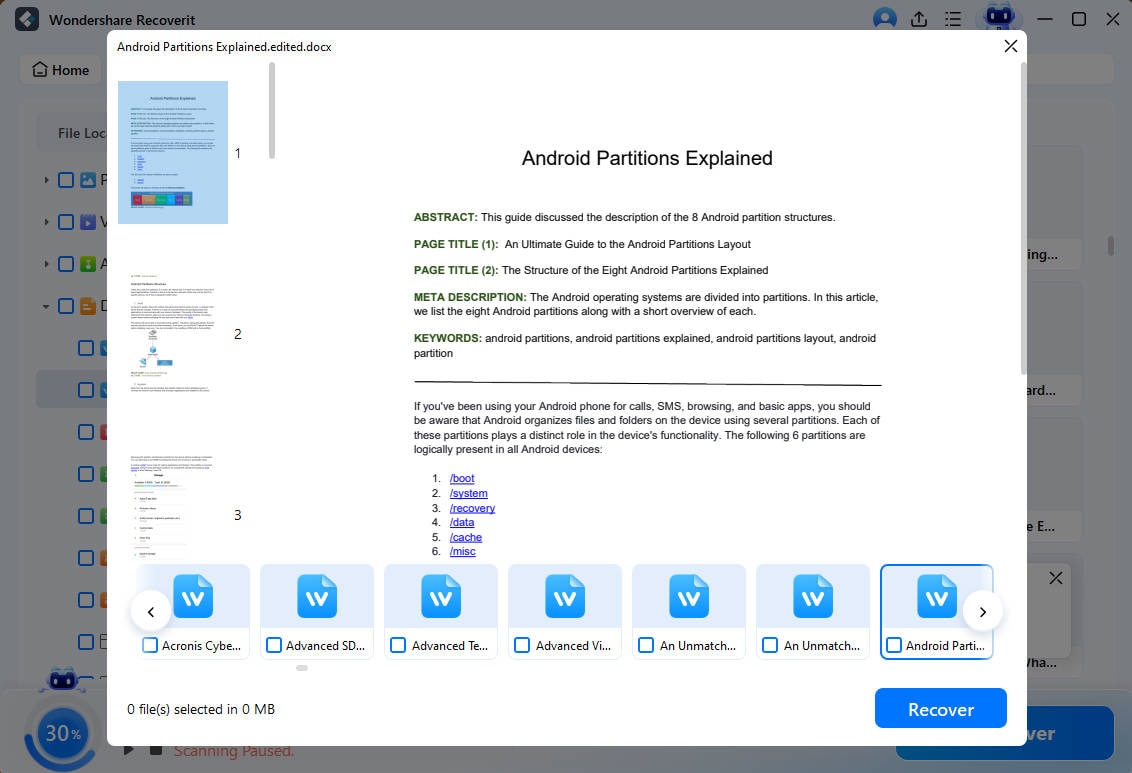
- You can also preview the data the app discovers to verify these are the files you want to restore. If they are, tap Recover to save them.
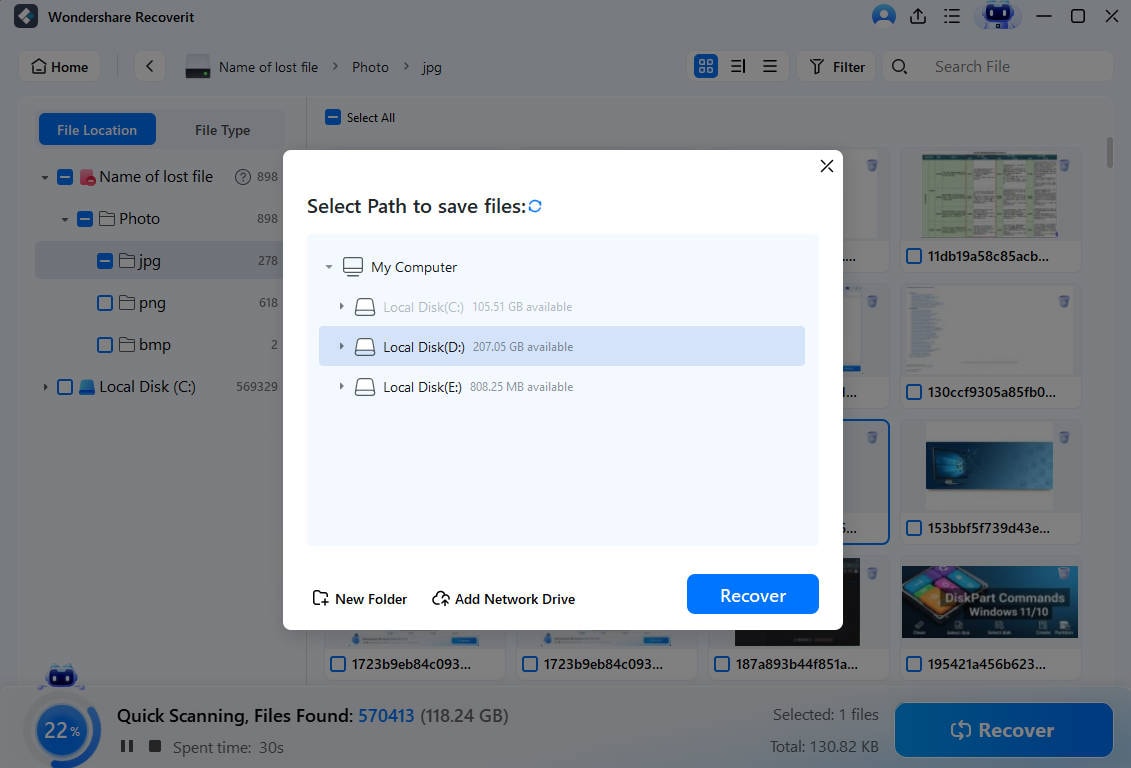
- Once the app finishes scanning, click Recover to save the files. Alternatively, you can pause or stop the scan at any moment and keep the items it has found.
That's all, and you're done. Thanks to the application's support for dozens of data loss situations, hundreds of file systems and formats, and thousands of storage devices, you can safely embark on any data recovery journey with Wondershare Recoverit, and it'll quickly restore your data.
How to Recover Unsaved Notepad Files
In most cases, recovering unsaved data is more straightforward than recovering deleted data. That's because your computer stores everything you do in its memory and keeps it there until you shut it down. These files are effortlessly recoverable; just don't shut down your PC.
📁 Step-by-Step: Manually Extracting Text Strings from Windows Temp Repositories
If you are using an older version of Windows or need to recover a text file after a sudden system crash, follow these steps to manually comb through the hidden Windows cache repositories:
- Open the Windows Run Executable Box: Press the Windows Key + R shortcut on your keyboard to launch the native Windows Run system utility console dialog box.
- Navigate directly to the Local AppData Directory: Type %localappdata% into the Open input field text box and press Enter. This bypasses hidden system folder restrictions and opens your local app repository profile immediately.
- Locate the Temporary Storage Cache: Scroll down to locate and double-click the Temp folder. This repository holds active cached operational data logs written by open running applications.
- Filter files by Text Data Signatures: Click into the upper-right search bar within File Explorer. Type .tmp or .txt and sort the results by Date modified to isolate files created at the exact minute your data was lost.
- Convert and Reconstruct the Text Document: Right-click the suspected temporary cache file, choose Open With, and select Notepad. If your lost text strings appear in the window, click File > Save As to save the text document safely to your desktop.

The time your PC stores something in its Temp folder depends on the file. It's worth noting that some files might be there for weeks, while others will be gone when you shut down your PC, so acting as soon as possible is highly recommended.
Methods for Recovering Deleted/Lost Notepad Files
Recovering deleted Notepad files and other types of lost data can be challenging. Nonetheless, there are multiple ways Windows users can go about it, so let's dig in.
Recover the Previous Version of Your Notepad File
Previous Notepad file versions come into play if you've made a mistake while editing your .txt file and accidentally saved it. You can recover a file's previous version by following these steps:
- Locate the Notepad file and right-click it.
- Select the Restore previous versions option.

- Choose the previous version and click Apply > OK.
It's worth noting that this method only works if you've previously set up the File History feature on your Windows machine, which creates snapshots of your files and saves multiple versions in the designated folder.
Retrieve Notepad Files With Recycle Bin
A deleted file doesn't immediately disappear. Instead, it first goes into the Recycle Bin, and unless you've manually emptied it, your .txt file might still be in there.
- Locate the Recycle Bin on the desktop and open it.
- Search for your text files by putting "txt" or the file's name in the search bar.
- Right-click a Notepad file and tap Restore.
By default, Recycle Bin files will stay there for up to 30 days unless you've changed the settings. To increase it, you can open Settings, navigate to System > Storage > Storage Sense, and change to 1, 14, 30, and 60 days, or Never.
Find Lost Notepad Files Using Windows File Recovery
Anyone who has dealt with Command Prompt knows how challenging command-line interfaces can be for an average user. Microsoft attempted to resolve that with its Windows File Recovery tool, simplifying such a user interface. It also makes the app a fantastic option for Notepad data recovery, and here's how you can use it:
- Launch the Microsoft Store, look for Windows File Recovery, and download and install the tool.
- Open the app, and you'll see notes on how to use it.

💻 Technical Execution: Running a Sector-Level Search via winfr
The native Windows File Recovery tool does not have a standard visual user interface. To use it successfully for `.txt` data recovery without syntax script failures, execute the command exactly as follows:
- Click the Windows Start menu button, type **cmd**, and select **Run as Administrator**.
- To run an advanced, deep structural parsing scan that looks for deleted `.txt` file signatures on an internal storage device, input the following exact operational string command:
cmd
winfr C: D:\NotepadRecovery /extensive /n *.txt
While far simpler than CMD, as it includes examples, Windows File Recovery is still based on it. Therefore, this command-line tool might be too complex for some users.
Perform Notepad Files Recovery Using Windows Backups
Windows Backup is an excellent built-in tool that works great for Notepad data recovery, as it restores data from a system restore point you've made earlier. Here's how to use it:
- Open the Control Panel, head to System and Security, and find Backup and Restore.

- Click the "Restore files from backup" option and follow the wizard to find, select, and restore your .txt files.
Remember that the Backup feature requires previous setup and existing backups. If you haven't used it before, you won't be able to restore Notepad files with it.
Conclusion
While Notepad is a simple and easy-to-use text editor for jolting down quick notes, it also lacks AutoSave and AutoRecover features, making Notepad files much more prone to data loss. Because of this, users often struggle with unsaved, lost, and deleted Notepad data.
In most cases, these files are recoverable. Unsaved Notepad data can often be found in the Temp folder, and that's even easier for users with Notepad++ due to the app's backup feature. Things are more complex regarding lost or deleted Notepad data.
However, methods like recovering from the Recycle Bin, through File History and Windows Backup, or with the Windows File Recovery app are all viable options.
Fortunately, universal solutions also exist, and Wondershare Recoverit is a fantastic example. With such an app at your disposal, you'll never again have to worry about data loss and can effortlessly recover unsaved, lost, and deleted Notepad files.
FAQ
-
Where Are Notepad Documents Saved?
By default, your Notepad documents will be saved in the Documents folder, which you can access by opening Windows' File Explorer and clicking the Documents folder in the Quick Access menu on the left. However, your unsaved Notepad documents will likely be in C:\Users\Your_User_Name\AppData\. -
Can I Recover Unsaved Notepad Files?
Yes, you can recover unsaved notepad files. Microsoft has recently added the AutoSave feature to Notepad in Windows 11, and your contents will be available the next time you open Notepad, even if you haven't saved your changes. On older versions of Windows, unsaved Notepad files can be recovered from the Temporary folder or through backups, Windows File Recovery, or Recycle Bin. -
Can I Back Up Notepad Files?
Absolutely. Notepad files can be backed up just like any other type of file. All you need is a dedicated backup application, like Wondershare UBackit, and you can safely and efficiently back up your vital Notepad documents to a safe location on your PC, USB, or network.


