

 TL;DR:
Determine your SD card security method based on your portability needs: use BitLocker on a supported Windows edition for a password-protected card that moves between computers, use Android internal storage to permanently bind the card to one phone, and always unlock an existing encrypted card on its original device before attempting formatting or recovery.
● Relying on BitLocker for removable media confidentiality creates a strict credential dependency, requiring you to save the recovery key separately to avoid permanent lockout if the standard password fails.
● Configuring a card as Android internal or adoptable storage requires formatting the drive and intentionally destroys device portability, meaning the card cannot be read normally by other phones, cameras, or PCs.
● The physical adapter lock switch only discourages writing rather than scrambling files, and tools like Wondershare Recoverit cannot bypass encryption and must only be used after the operating system detects the unlocked card as normal storage.
Ask AI for a summary
 ChatGPT
 Perplexity
 Gemini
 Claude
 Grok
Grok
⚡ TL;DR: Quick Fix
● Want A Removable Password-Protected SD Card On A PC? Use BitLocker on a supported Windows edition and save the recovery key before you trust the card with important files.
● Want Android To Secure The Card For One Phone? Choose internal/adoptable storage only if you accept that the card is no longer meant to move freely between devices.
● Your Card Already Says Encrypted? Go back to the original phone, computer, password, or recovery key before you format, reset, or run recovery software.
● The Lock Switch Is Not Encryption: It only creates write protection on readers that honor the switch. It does not hide files or add a password.
Quick answer: If you want a removable SD card that stays removable but asks for a password on a Windows PC, use BitLocker on a supported Windows edition. If you want Android to secure the card for one phone, use internal or adoptable storage only on a device that offers that option. If the card already says encrypted and you need the files back, return to the original device or unlock it with the correct password, PIN, or recovery key before you format anything.
You may be trying to do one of three different things: add password protection to a removable SD card, let Android turn the card into phone-only storage, or open a card that already appears encrypted. Use the matching route below so you do not lock yourself out, erase the card too early, or turn a removable card into device-bound storage by mistake.
Fact-checked on September 9, 2026: This page was checked against current Google Android Help, Microsoft BitLocker documentation, and Microsoft recovery-key guidance.
In This Article
Choose The Right SD Card Encryption Path First
Start by matching the card to the job you want it to do. A removable card with password protection, a phone-only Android storage card, and a card that already appears encrypted each need a different next step.
| If this is your real goal | Use this route | What you should not do first |
| You want a removable SD card that still works like a removable drive but asks for a password on a Windows PC | Encrypt the card with BitLocker on a supported Windows edition | Do not assume Android-style storage encryption or the lock switch will do the same job |
| You want one Android phone to secure the card as part of that phone's own storage | Use internal or adoptable storage if the device offers it | Do not expect the card to stay freely readable in another phone, camera, or PC |
| The card already says encrypted and another device cannot read it | Return it to the original phone or PC and unlock it before any recovery or reformat | Do not accept a format prompt just to “test” the card |
| You only want to stop accidental deletion or writing | That is write protection, not encryption | Do not treat the adapter lock switch as real file security |
If the card already looks unreadable, do not guess. Check whether the card came from a Windows BitLocker workflow, an Android phone that set it up as internal storage, or a reader with the adapter lock switch enabled.
Scenario A. You Want A Password-Protected Removable SD Card
If you want privacy on a removable SD card that still behaves like removable media, use BitLocker on a supported Windows edition. This is the correct route when you want a true password protected sd card in a Windows workflow.
Use this route when the card will be inserted into a Windows workflow and you want the card itself to require unlocking. Do not use this route if your real goal is “make this Android card belong to my phone,” because that is a different storage model entirely.
- Insert the SD card into a Windows PC that supports BitLocker.
- Open Control Panel and go to BitLocker Drive Encryption.
- Select the SD card and choose Turn On BitLocker.
- Create the unlock password and save the recovery key somewhere separate from the card.
- Complete the encryption process and eject the card only after Windows reports that the job is finished.
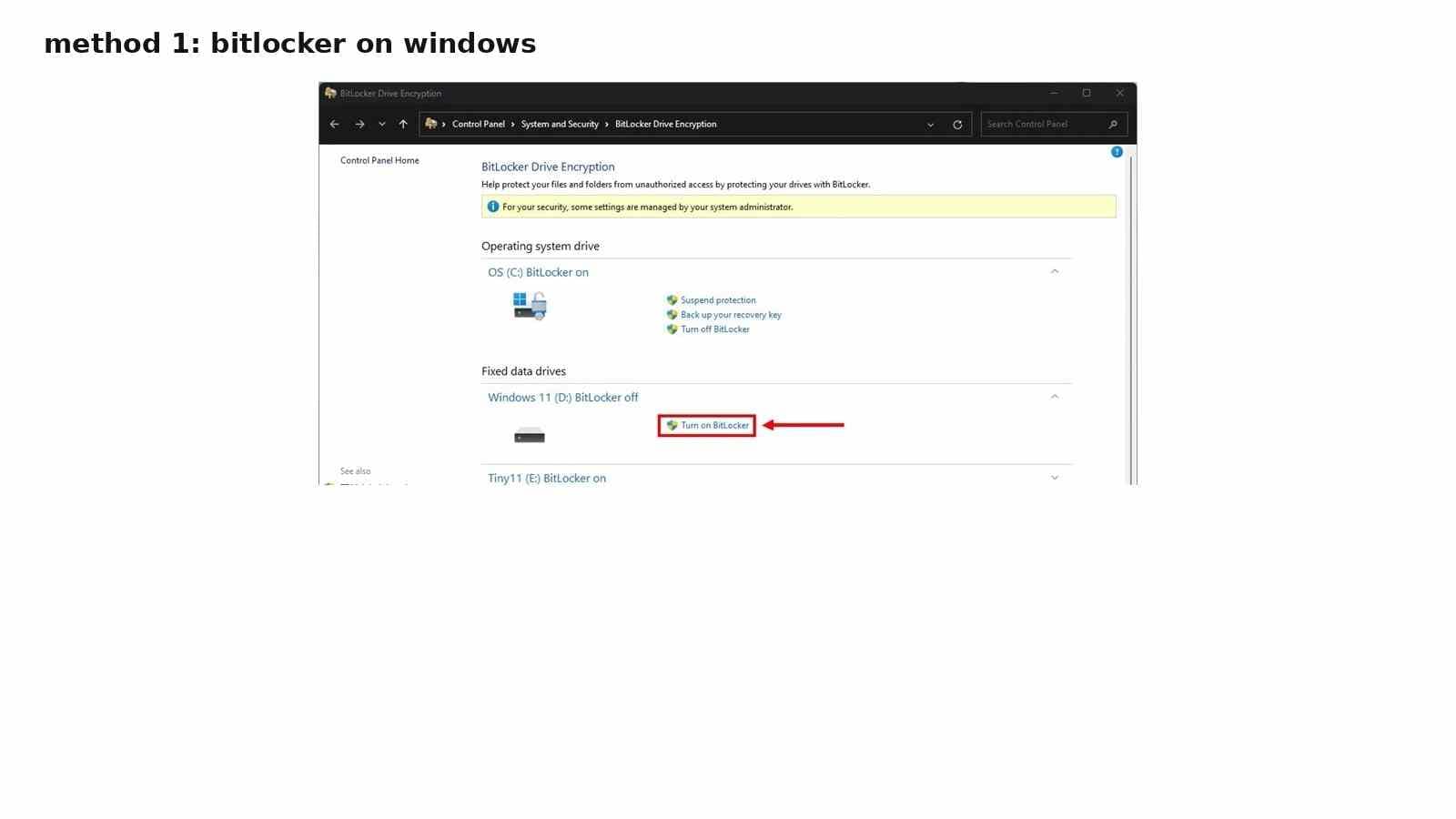
Microsoft describes BitLocker as full-volume encryption, and its own support guidance makes the recovery key a non-optional part of the workflow, not an afterthought. If normal unlocking fails later, that saved recovery key is what stands between you and permanent lockout. See Microsoft's BitLocker overview and Microsoft's recovery-key guide.
The tradeoff is simple: this route protects confidentiality well, but it also creates a credential dependency. If you lose both the password and the saved recovery key, this stops being a storage problem and becomes an access problem.
Scenario B. Your Phone Wants To Turn The Card Into Phone-Only Storage
If you want Android to secure the card for one phone, focus on the storage mode. Current Android guidance centers on portable storage and internal/adoptable storage, not on one universal removable-card password switch for every device.
If you choose internal or adoptable storage, the card is no longer being treated like ordinary removable media. It becomes tied to that phone's storage model. That is useful only when your priority is adding phone storage, not when your priority is easy movement between devices.
- Insert the SD card and wait for the SD card detected notification.
- Tap the notification and choose Format another way if you want the phone-only internal-storage route.
- Read the warning carefully, because Android will erase the card during setup.
- After setup, choose whether to move content now or later if the phone offers that choice.
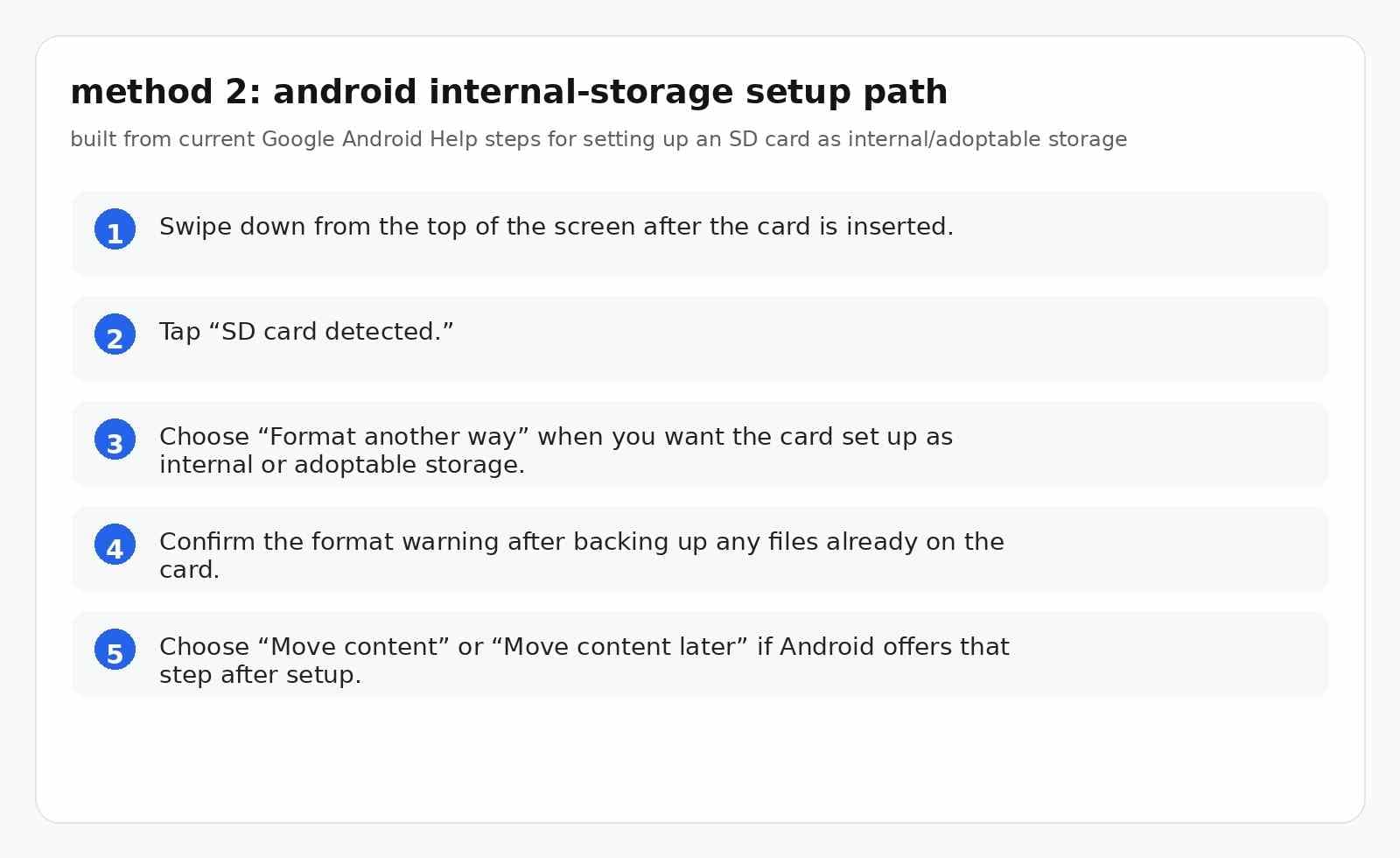
| Before you choose internal storage | Why it matters |
| You will format the card | Any files still on the card need backup or recovery first |
| The card is no longer meant to move freely between devices | Another phone, camera, or PC may no longer read it normally |
| Your original phone becomes part of the access path | Removing the card and testing it elsewhere can create panic even though the card is behaving as configured |
| Not every Android brand or model exposes the same option | Older screenshots and forum posts may show menu paths your phone does not have |
Google's current guidance is explicit that internal storage is for files and apps on that device and is not intended to transfer between devices. That is the real meaning behind many “my sd card is encrypted” complaints on Android. See Google's current SD card setup guide.
Scenario C. The Card Already Says Encrypted And You Just Need The Files
If the files matter, do not format the card just to see whether it becomes readable again. Go back to the original device or the correct unlock credential first.
- Go Back To The Original Environment: If the card came from an Android phone using internal storage, try the same phone first. If the card was encrypted on Windows, return to the same PC or another BitLocker-capable Windows system.
- Unlock Before You Troubleshoot: Use the correct password, PIN, or recovery key. Recovery software does not replace the decryption secret.
- Copy Files Out Before You Change Storage Modes: Once the card opens normally again, move the important files to a computer or another external drive before you switch modes or reformat anything.
- Only Then Decide Whether You Need Recovery Software: If files are still missing after the unlocked card mounts normally, recovery becomes a reasonable next step.
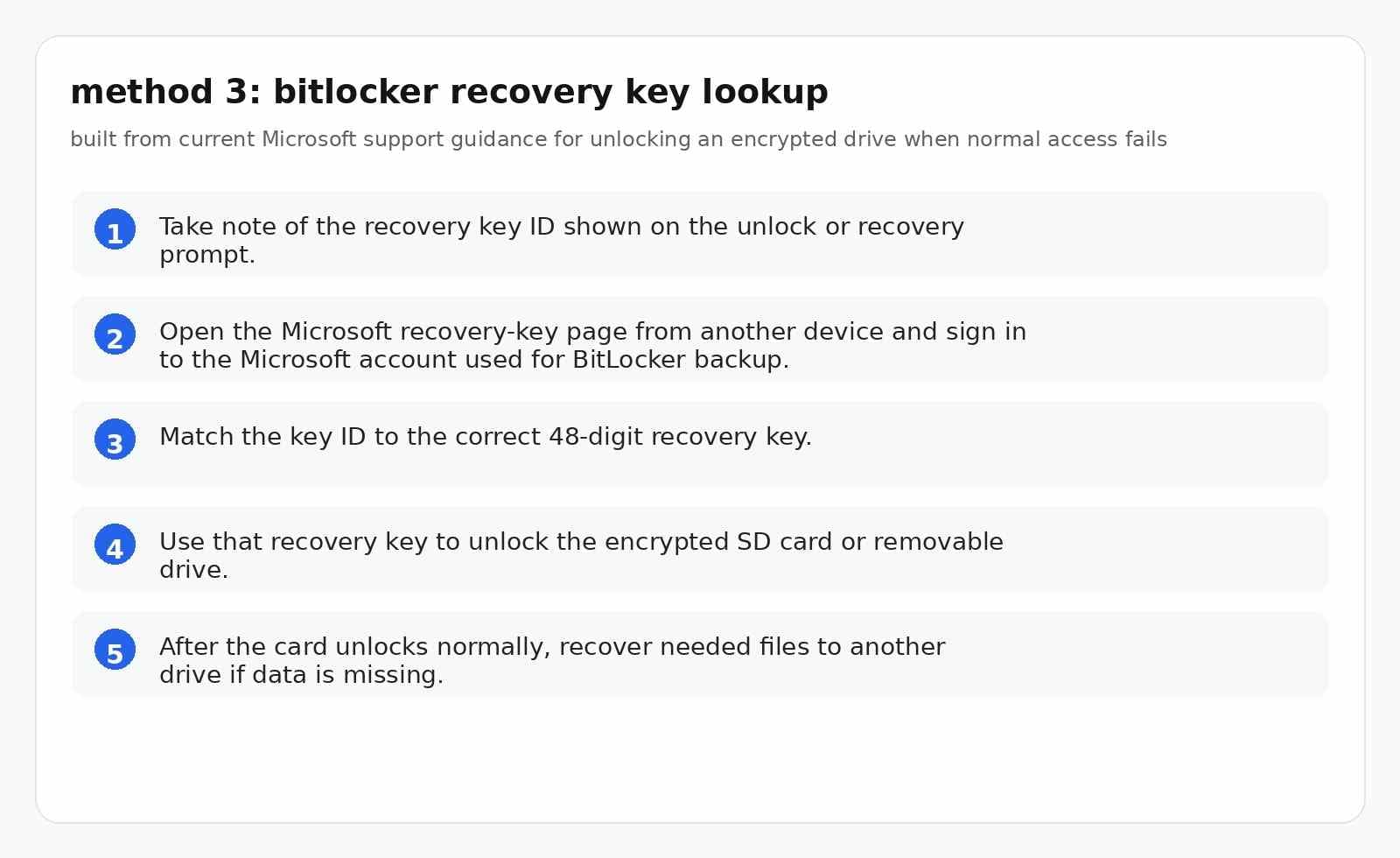
For BitLocker-protected media, Microsoft's guidance is direct: if ordinary unlocking fails, use the recovery key. For Android-tied storage, the original phone can be just as important as any credential. Unlock the card first and copy the files out before you change modes or reformat the card.
If the card finally unlocks but some files are gone, stop writing to it. At that point, a recovery-first workflow is appropriate. This formatted SD card recovery guide helps if a format already happened, while this SD card error guide is a better fit when the card stays readable but unstable.
Know What Each Option Protects Before You Turn It On
Check what each option really does before you turn it on. These controls do not protect the card in the same way.
| Option | What it protects | What you give up |
| BitLocker on a removable SD card | Confidentiality if the card is lost or stolen | You now depend on the password and recovery key |
| Android internal or adoptable storage | Phone-tied access and tighter device integration | The card stops behaving like easy removable storage |
| An encrypted app vault or container on the card | Only the files inside that app or container | You still depend on the same app and password to open it |
| The physical lock switch on an SD adapter | Nothing confidential; it only discourages writes | You get read-only behavior, not real privacy |
This comparison is the clearest answer to searches like encrypt sd card meaning and meaning of sd card encryption. The correct choice depends less on the card itself and more on whether you care most about privacy, phone-only use, or simple write protection.
Do Not Confuse These SD Card Security Methods
Do not treat the lock switch as encryption. The adapter switch can make a card read-only in some readers, but it does not scramble the files or stop someone else from reading them on another device.
Do not assume every Android phone has the same menu path. Search results and forum posts may quote older manufacturer-specific paths or outdated Android versions. Follow the current menu your phone shows.
Do not jump from “encrypted” straight to formatting. If the card became unreadable because it is tied to a phone or protected by BitLocker, formatting can destroy the easiest route back to the files.
Do not expect recovery software to bypass encryption. If the operating system cannot read the locked card, recovery software has nothing useful to scan until you unlock the card first.
Use Recoverit Only After The Card Is Unlocked
Use Wondershare Recoverit after the SD card is unlocked and detected as normal removable storage by a Windows PC or Mac. Recoverit is not a password bypass tool, a BitLocker key replacement tool, or a way to turn another phone's adoptable-storage card into ordinary removable media.
- Connect The Unlocked Card: Insert the SD card through a reliable reader, open Recoverit, and choose SD Card Recovery.
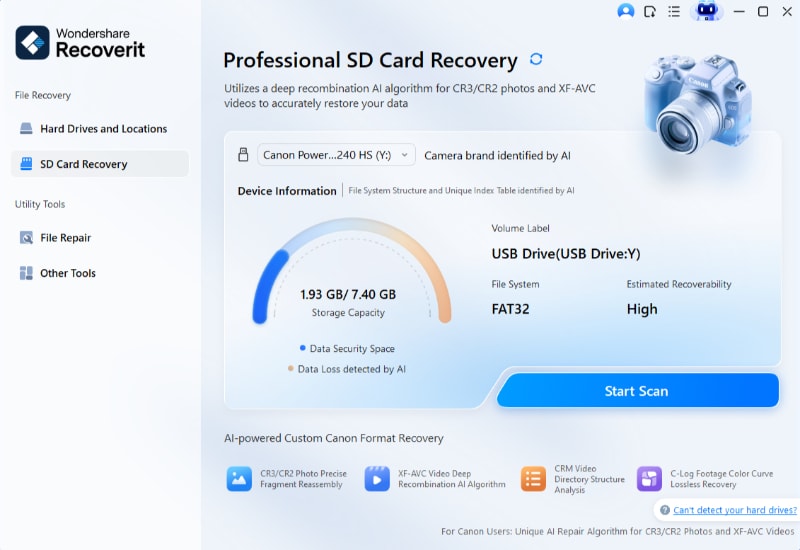
- Scan Without Writing To The Card: Let Recoverit search the unlocked card for deleted, formatted, or inaccessible files.
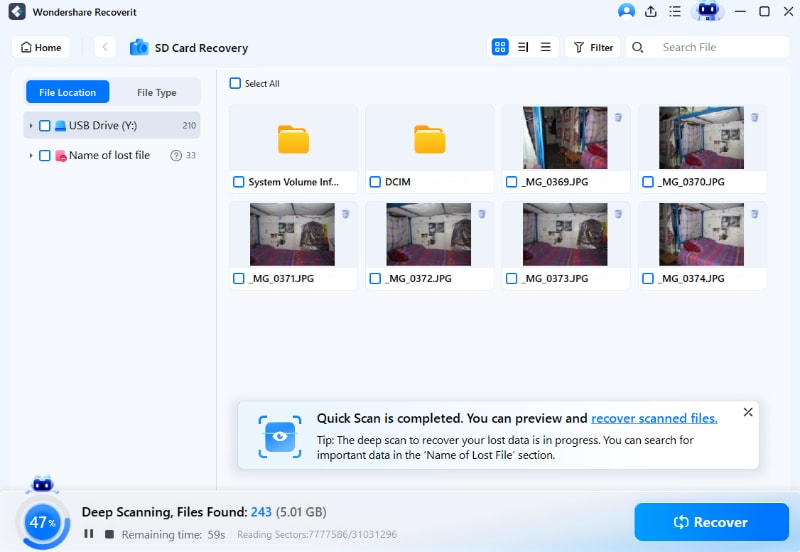
- Preview And Save Elsewhere: Preview the files you need and recover them to the computer or another external drive, never back to the same SD card.

Try Wondershare Recoverit to Perform Data Recovery
 Security Verified. Over 7,302,189 people have downloaded it.
If the card is still locked, tied to another device, or asking for a missing recovery key, solve that access problem first. If the card is unlocked but unstable, recover the files before you experiment with reformatting, CHKDSK, or repeated repairs.
Conclusion
If you want a removable password-protected SD card, use BitLocker and protect the recovery key. If you want Android to absorb the card into one phone, choose internal storage only after you accept the portability tradeoff. If the card already says encrypted and the files matter, go back to the original device or credential before you do anything destructive.
Choose the route that matches your goal: removable-card privacy, phone-only storage, or file rescue. That keeps you from erasing the card too early or locking yourself into the wrong storage mode.
FAQ
-
How Do I Encrypt A Removable SD Card With A Password On Windows?
Use BitLocker on a supported Windows edition. Insert the SD card, open BitLocker Drive Encryption, turn on BitLocker for that card, create a password, and save the recovery key before encryption starts. -
What Does “SD Card Is Encrypted” Usually Mean On Android?
It often means the card was set up as internal or adoptable storage and became tied to that phone instead of remaining ordinary removable media. In that state, another device may not read it normally. -
Is The SD Card Lock Switch The Same As Encryption?
No. The lock switch only creates write protection on readers that honor it. It does not add a password, hide files, or provide real confidentiality. -
Can I Move An Android-Enrolled SD Card To Another Device?
If the phone set the card up as internal or adoptable storage, you should not expect it to behave like a freely movable SD card. The original phone often remains part of the access path. -
Should I Format An Encrypted SD Card That Suddenly Looks Unreadable?
No, not before you try the original device, password, PIN, or recovery key. Formatting can destroy the easiest path back to the files and make later recovery harder. -
Can Recoverit Recover Files From An Encrypted SD Card?
Recoverit can help after the card is unlocked and the operating system detects it as normal removable storage. It does not decrypt the card or replace a missing BitLocker recovery key or Android device binding. -
What If I Forgot The BitLocker Password And Recovery Key?
Microsoft states that a lost BitLocker recovery key cannot be recreated by support. Without the working password or saved recovery key, access to the encrypted data may be permanently blocked.


